
KHUYẾN CÁO Y TẾ QUAN TRỌNG: Liệu pháp hormone (HRT) cho người chuyển giới là một quá trình can thiệp y khoa phức tạp, đòi hỏi tính cá nhân hóa cao và tiềm ẩn nhiều nguy cơ đối với sức khỏe nếu không được kiểm soát đúng cách. Tuyệt đối KHÔNG tự ý sử dụng thuốc dựa trên các thông tin tham khảo hoặc chia sẻ trên mạng. Việc tự điều trị mà không có sự giám sát y tế có thể dẫn đến các biến chứng nguy hiểm tính mạng như độc tính trên gan, thuyên tắc mạch do huyết khối, hoặc u màng não. Luôn luôn tìm kiếm sự thăm khám, tư vấn và theo dõi định kỳ từ các bác sĩ chuyên khoa nội tiết có chuyên môn để đảm bảo an toàn tối đa cho bản thân.
Tài liệu tham khảo sau đây là bản dịch tiếng Việt chính thức dưới sự cho phép bởi tác giả Aly W. thuộc TransfemScience.
Bài viết gốc: An Introduction to Hormone Therapy for Transfemnine People by Aly
Giới thiệu liệu pháp hormone nữ hoá (HRT)
Mục tiêu của liệu pháp Hormone đối với người chuyển giới, còn được gọi là liệu pháp thay thế Hormone từ nam sang nữ (MtF) hoặc liệu pháp hormone nữ hóa (FHT-feminizing hormone therapy) là để tạo sự nữ hóa trên cả cơ thể và tâm hồn. Việc trị liệu bằng các loại thuốc Hormone sinh dục hoặc kích thích tố sinh dục được sử dụng làm trung gian cho quá trình thay đổi này. Hormone sinh dục gồm có Estrogens (E), Progestogens(P), và Androgens. Nồng độ Hormone sinh dục trong cơ thể là do tuyến sinh dục sản xuất từ khi ta được sinh ra. Đàn ông thì có tinh hoàn, nó sản xuất 1 lượng lớn nồng độ Hormone Androgens(Hormone sinh dục nam) và rất thấp Estrogens (Hormone sinh dục nữ). Trong khi phụ nữ có buồng trứng, nó sản xuất 1 lượng lớn Estrogens và progestogens trong khi nồng độ Androgens lại rất thấp.
Do đó, những người chuyển giới, chẳng hạn như người chuyển giới nữ, sẽ được dùng các thuốc Estrogens, progestogens và Anti-Androgens (Kháng hormone nam- AAs) để điều chỉnh lại nồng độ hormone sinh dục trong máu từ của nam sang nữ.
Các hormones sinh dục
Estrogens chính trong cơ thể là Estradiol (E2), Progestogens chính là Progesterone (P4), và Androgens chính là Testosterone (T) và dihydrotestosterone (DHT). Các hormones sinh dục chịu trách nhiệm cho việc phát triển các đặc điểm giới tính thứ cấp. Chúng làm trung gian tác động bằng cách hoạt động như chất chủ vận (hoặc chất kích hoạt) các thụ thể bên trong tế bào. Những thụ thể này bao gồm thụ thể androgen (AR), thụ thể estrogen (ER) và thụ thể progesterone (PR). Sau khi được kích hoạt, các thụ thể này điều chỉnh biểu hiện gen để ảnh hưởng đến tế bào.
Estrogens gây ra sự nữ hóa, trong đó có sự phát triển ngực, làm mềm mượt da, phân bố mỡ giống nữ (tập trung ở ngực, mông, đùi và hông, mở rộng và làm cong xương chậu (ở những người mà các đầu xương chưa bị đóng), và các thay đổi khác. Estrogens cũng là hormone chính phụ trách cho sự ham muốn tình dục ở nữ.
Progestogens về cơ bản không có vai trò nào được biết đến trong việc phát triển các đặc điểm nữ hóa hoặc góp phần phát triển ngực. Một số người chuyển giới nữ tuyên bố đã cải thiện sự phát triển của ngực với progestogen, thì sự liên quan của các hormone này đối với kích thước hoặc hình dáng của ngực vẫn còn gây tranh cãi nhiều và hiện nay không được ủng hộ. Thay vì đóng vai trò trong quá trình nữ hóa, progestogen có tác động quan trọng trong hệ thống sinh sản nữ và là hormone thiết yếu khi mang thai. Ngoài ra, nó cũng làm giảm tác động của Estrogens tại một số phần của cơ thể, ví dụ như tử cung, âm đạo và vú.
Trong khi đó Androgens gây ra những đặc điểm nam hóa, bao gồm sự phát triển và dài ra của dương vật, làm nở rộng vai và ngực, nở rộng xương sườn, thúc đẩy sự tăng trưởng cơ bắp, giọng nói trầm, phân bố mỡ theo kiểu của nam(tập trung ở bụng và eo), sự phát triển của lông mặt, lông cơ thể. Nó cũng gây ra sự ham muốn tình dục rõ rệt ở nam và kích thích (chẳng hạn như cương cứng tự phát). Androgens gây ra mụn trứng cá, bã nhờn, da dầu, rụng tóc, mùi cơ thể. Và ngăn chặn sự phát triển của tuyến vú.
Ngoài ra, hormones sinh dục cũng tác động đến não, gây ảnh hưởng đến nhận thức, cảm xúc và hành vi. Chúng cũng có tác động quan trọng với sức khỏe, cả về mặt tích cực và tiêu cực. Ví dụ, hormones Androgen tạo ra ham muốn và kích thích tình dục rõ rệt (bao gồm cả cương cứng tự phát). estrogen duy trì sức mạnh của xương và có khả năng bảo vệ chống lại bệnh tim , nhưng cũng làm tăng nguy cơ ung thư vú.
Thời gian tác động của các hormone sinh dục
Trong giai đoạn dậy thì bình thường ở cả nam và nữ, sự tiếp xúc với hormone sinh dục bắt đầu ở mức rất ít và tăng dần lên, chậm rãi trong nhiều năm và kết quả là sự trưởng thành về mặt giới tính xảy ra dần dần. Ở những người chuyển giới chưa dậy thì hoặc đã trải qua dậy thì, lượng hormone cao thường được sử dụng ngay từ ban đầu và điều này có thể dẫn đến những thay đổi về đặc điểm giới tính thứ cấp ra nhanh hơn nhiều. Bảng dưới đây được sao chép lại từ các nguồn tài liệu với sự sửa đổi nhỏ và thường được trích dẫn như một mốc thời gian về tác dụng của liệu pháp hormone ở người chuyển giới (Wiki-Table). Nó dựa trên sự kết hợp giữa kinh nghiệm lâm sàng, ý kiến chuyên gia và các nghiên cứu lâm sàng về những người chuyển giới.
| Tác động | Khởi phát (1) | Hoàn thành (1) | Tính bền vững khi dừng thuốc |
| Phát triển vú | 2–6 tháng | 1–3 năm | Vĩnh viễn |
| Giảm hoặc làm chậm sự phát triển của lông mặt và lông cơ thể | 3–12 tháng | > 3 năm (2) | Có thể đảo ngược |
| Chấm dứt hoặc đảo ngược tình trạng rụng tóc | 1–3 tháng | 1–2 năm | Có thể đảo ngược |
| Làm mềm da và giảm nhờn da, giảm mụn trứng cá | 3–6 tháng | Không xác định | Có thể đảo ngược |
| Phân bố lại lượng mỡ trong cơ thể theo kiểu nữ tính | 3–6 tháng | 2–5 năm | Có thể đảo ngược |
| Giảm khối lượng cơ | 3–6 tháng | 1–2 năm (3) | Có thể đảo ngược |
| Mở rộng và làm tròn khung xương chậu (4) | Không xác định | Không xác định | Vĩnh viễn |
| Thay đổi tâm trạng, cảm xúc và hành vi | Ngay tức khắc | Không xác định | Có thể đảo ngược |
| Giảm ham muốn tình dục và cương cứng tự phát | 1–3 tháng | 3–6 tháng | Có thể đảo ngược |
| Rối loạn cương dương và giảm xuất tinh | 1–3 tháng | Không xác định | Có thể đảo ngược |
| Giảm sản xuất tinh trùng và vô sinh | không xác định | > 3 năm | Tùy cá thể (5) |
| Giảm thể tích tinh hoàn | 3–6 tháng | 2–3 năm | không xác định |
| Thay đổi giọng nói | Không (6) | Không | Không xảy ra |
(2) = Liệu pháp hormone thường ít ảnh hưởng đến mật độ lông mặt ở những người chuyển giới. Có thể triệt lông bằng điện phân hoặc laser.
(3) = Có thể thay đổi đáng kể tùy thuộc vào tập thể dục, vận động nhiều hay ít.
(4) = Chỉ xảy ra ở những người trẻ chưa hoàn thành quá trình đóng sụn tăng trưởng xương (có thể hoàn toàn không xảy ra ở những người sau tuổi dậy thì).
(5) = Chỉ có estrogen, đặc biệt ở liều cao, mới có khả năng gây vô sinh lâu dài hoặc không thể phục hồi;
Suy giảm khả năng sinh sản do thuốc Antiandrogen gây ra thường dễ dàng hồi phục khi ngừng thuốc.
(6) = Luyện tập nữ hóa giọng nói là 1 lựa chọn rất tốt
Nồng độ hormone bình thường ở nam và nữ
Ở người chuyển giới nữ sử dụng HRT, xét nghiệm nồng độ hormone sinh dục trong máu để giúp xác định rằng nồng độ hormone của họ đã được điều chỉnh đúng bằng việc dùng các thuốc nội tiết và nồng độ đó nằm trong phạm vi bình thường của nữ.
Nồng độ hormone có thay đổi khác nhau nhưng theo cách dự đoán được trong chu kỳ kinh nguyệt bình thường của phụ nữ hợp giới.
- Pha nang noãn: nửa đầu của chu kỳ hoặc các ngày từ 1–14
- Giữa chu kỳ: Các ngày từ 12–16 hoặc lâu hơn
- Giai đoạn hoàng thể: nửa sau của chu kỳ hoặc các ngày từ 14–28
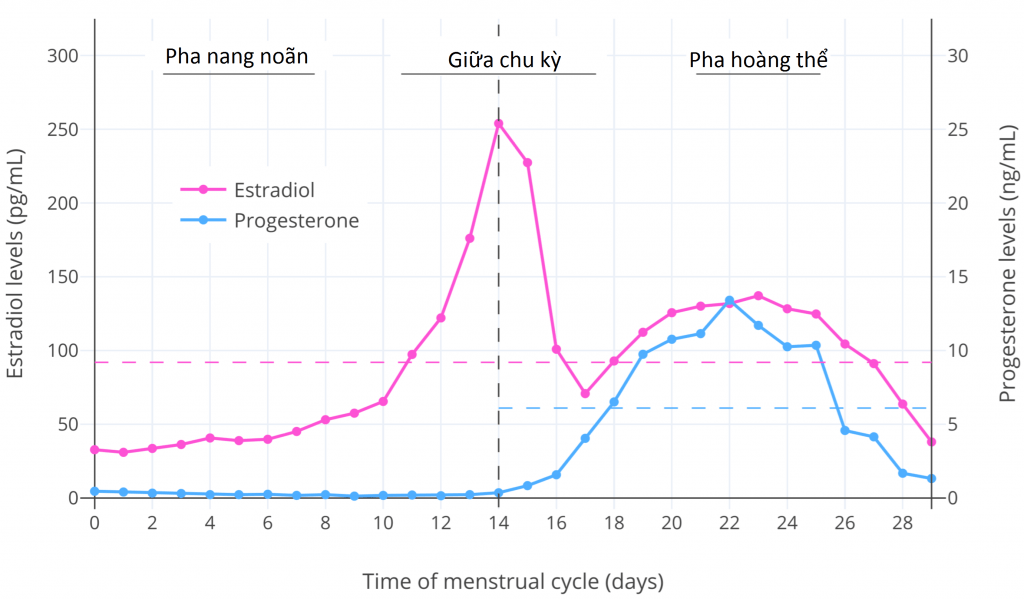
Như có thể thấy từ biểu đồ, nồng độ estradiol tương đối thấp và nồng độ progesterone rất thấp trong pha nang; nồng độ estradiol nhanh chóng tăng lên mức rất cao, và kích hoạt rụng trứng trong thời gian giữa chu kỳ; nồng độ estradiol và progesterone trải qua một đợt va chạm và đều tương đối cao trong giai đoạn hoàng thể (mặc dù estradiol không cao như trong thời kỳ đỉnh điểm giữa chu kỳ).
Bảng dưới đây cho thấy phạm vi giá trị cho nồng độ estradiol, progesterone và testosterone ở cả nữ và nam, cho phép so sánh nồng độ hormone giữa nam và nữ.
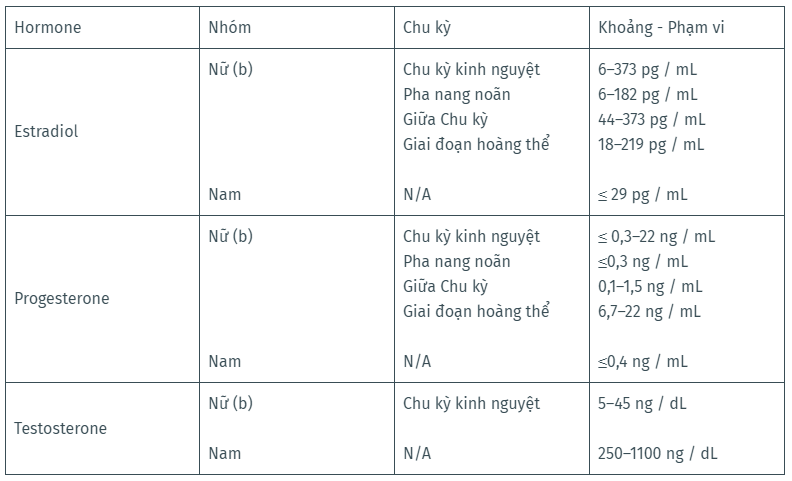
Nồng độ Estradiol (E2) ở nữ trung bình khoảng 100 pg/mL và ở nam là 25 pg/mL, trong khi nồng độ Testosterone trung bình ở nữ vào khoảng 30 ng/dL còn ở nam là 600 ng/dL. Dựa trên những giá trị này, mức độ testosterone trung bình ở nam giới cao gấp khoảng 20 lần so với nữ.
Ngoài các giá trị trong bảng, nồng độ Testosterone trung bình ở những người phụ nữ có triệu chứng thừa Androgen (ví dụ, mọc lông trên mặt / cơ thể) do chứng buồng trứng đa nang là khoảng 60 ng/dL. Do đó, với phụ nữ ngay cả khi nồng độ Testosterone tăng nhẹ hơn mức bình thường cũng có khả năng gây ra các tác dụng quá mức trên cơ thể.
Mục tiêu của liệu pháp hormone nữ hóa cho người chuyển giới là đạt được cả 2 mức nồng độ Estradiol và Testosterone trong phạm vi bình thường của nữ. Các phạm vi thường được khuyến nghị trong nhiều tài liệu là 100 đến 200 pg/mL đối với mức estradiol và dưới 50 ng/dL đối với nồng độ testosterone (Wiki-Table). Nhưng trên thực tế, thường thì nồng độ estradiol cao hơn sẽ rất hữu ích để giúp ức chế mức testosterone.
Ức chế tuyến sinh dục
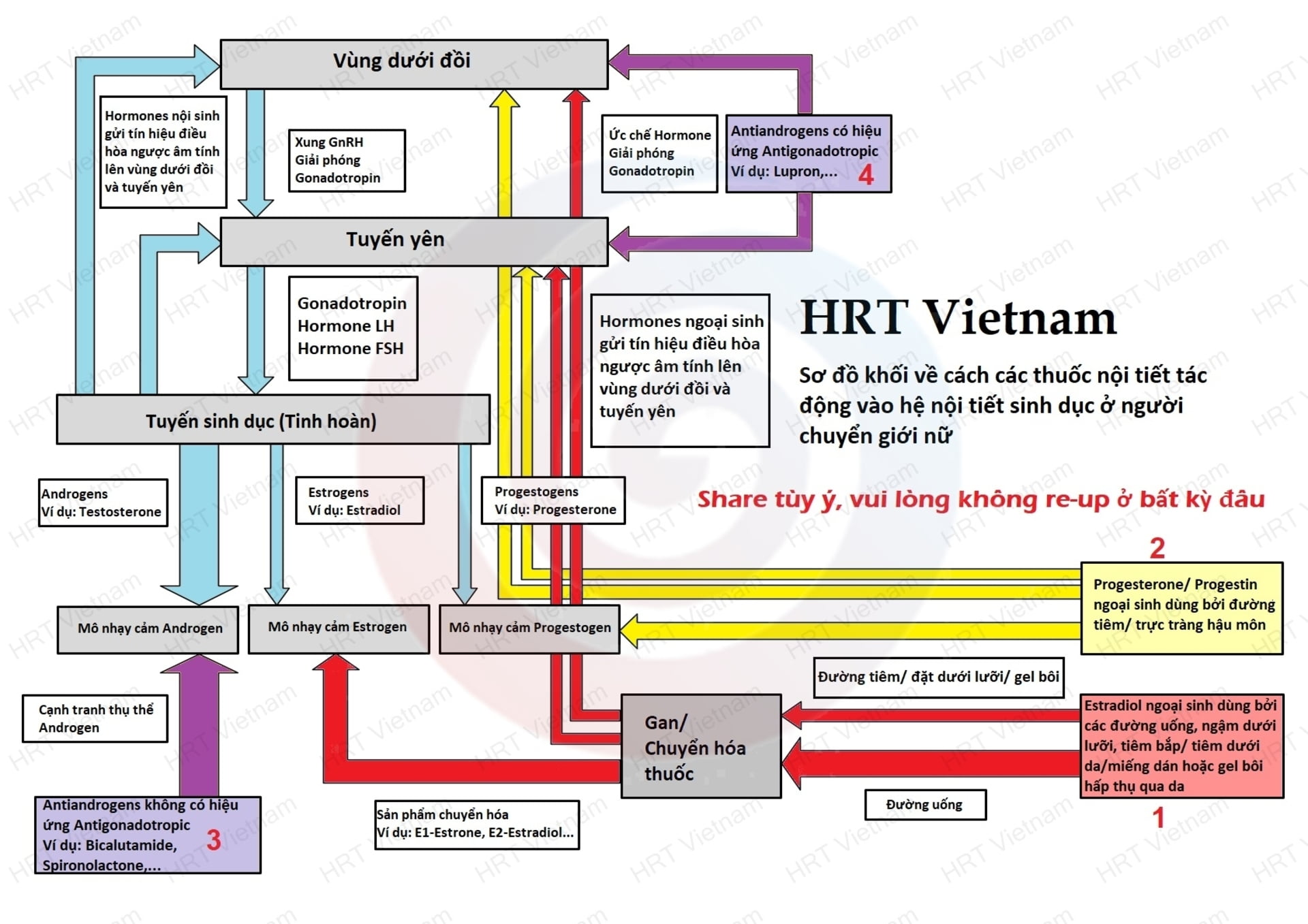
Ngoài những tác dụng tổng quát lên cơ thể và não bộ, Estrogens, progestogens, Androgens còn có hiệu ứng Antigonadotropic. Nghĩa là, nó ức chế Hormone giải phóng Gonadotropin (GnRH) và hạn chế tuyến yên bài tiết ra các gonadotropin, là Hormones tạo hoàng thể (LH) và hormone kích thích nang trứng (FSH), những hormone này mang tín hiệu đến các tuyến sinh dục để tạo ra các hormones sinh dục và hỗ trợ những gì cần thiết cho các tế bào tinh trùng hoặc trứng sinh sản. Nếu nồng độ gonadotropin bị ức chế đủ — > Các tuyến sinh dục sẽ không còn sản xuất ra hormones sinh dục nữa và khả năng sinh sản sẽ bị ngừng, khoảng 95% các hormone sinh dục trong cơ thể được tạo ra bởi các tuyến sinh dục. Với nồng độ đủ cao, Estrogens có thể ức chế tối đa nồng độ Testosterone đến 95% ở Nam cũng như ở người chuyển giới nữ. Trong khi progestogens có thể ức chế tối đa nồng độ của Testosterone từ 70-80%. Nồng độ Estradiol (E2) ở mức 200 pg/mL có thể ức chế nồng độ Testosterone đến 90% (~50 ng/dL), còn khi nồng độ Estradiol (E2) ở mức 500 pg/mL có thể ức chế nồng độ Testosterone đến 95% (~20 ng/dL). Việc dùng liều cao Estrogens hoặc Progestogens với hiệu ứng ức chế Hormone giải phóng Gonadotropin thường được tận dụng trong liệu pháp hormone nữ hóa cho người chuyển giới để ngừng hẳn việc sản xuất Testosterone tại tinh hoàn. Việc kết hợp Estrogens và Progestogens được sử dụng để ức chế tối đa nồng độ Testosterone với liều thấp hơn mức khi dùng riêng lẻ Estrogens hoặc Progestogens. Sau đây là 1 ví dụ về việc ức chế nồng độ Testosterol bằng liệu pháp Estradiol. (Wiki-Graph):
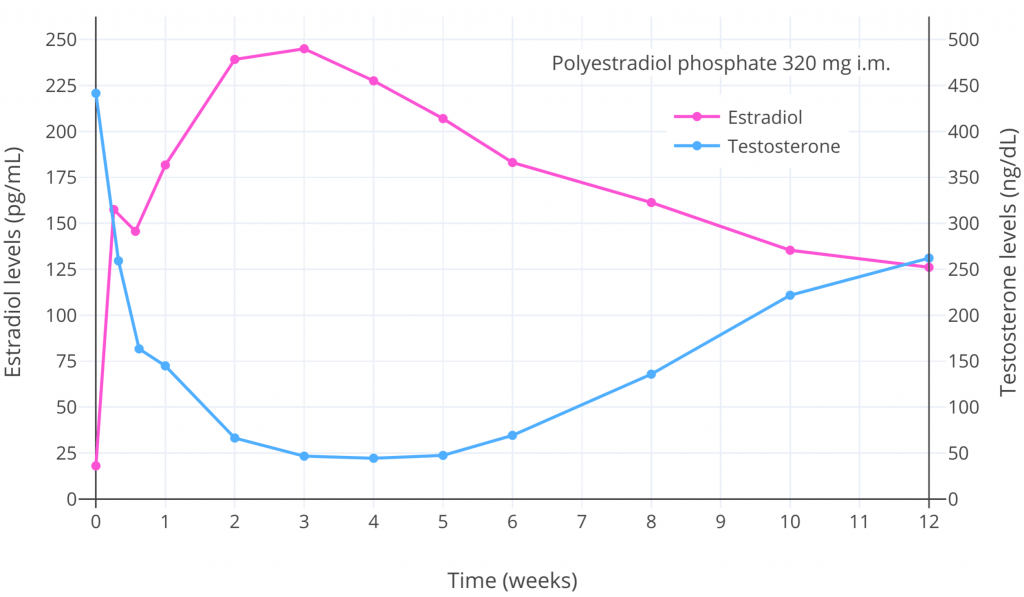
Nồng độ Estradiol và Testosterone sau khi tiêm 1 mũi polyestradiol phosphate (PEP) (tiền chất của Estradiol) ở nam bị ung thư tuyến tiền liệt (Stege et al., 1996). Mức giảm cao nhất của nồng độ Testosterone xảy ra khi nồng độ Estradiol lớn hơn 200pg/mL và là giảm khoảng 90%.
Cần lưu ý rằng những con số trước đây về ức chế testosterone bằng estrogen và progestogen là giá trị trung bình, có sự khác biệt đáng kể giữa các cá nhân về mức độ ức chế testosterone. Nói cách khác, một số người có thể cần nhiều hơn hoặc ít hơn về liều lượng thuốc để đạt được mức giảm testosterone tương tự.
Các loại thuốc nội tiết
Estrogen
Estrogens được sử dụng trong liệu pháp thay thế hormone ở người chuyển giới nữ gồm Estradiol và Estradiol Esters. Ví dụ cho Estradiol Esters là những chất:
Chúng đều là prodrug (tiền chất) của Estradiol
Tiền chất là gì? Các chất trên đều chuyển hóa thành Estradiol (E2) khi ở trong cơ thể và đều là các Estrogens đồng nhất sinh học (Bio-identical)
Mặt khác, Các Estrogens dạng không đồng nhất sinh học (non-bioidentical) ví dụ như:
- Ethinyl-Estradiol (EE) – được sử dụng gần như độc quyền trong các loại thuốc tránh thai (Dùng trong các thuốc Diane-34, Beriz, OC-35,…) – Các thuốc này làm tăng nguy cơ hình thành huyết khối tĩnh mạch sâu, cực kỳ không khuyến cáo sử dụng
- Conjugated-Estrogen (CEEs-Estrogen liên hợp từ nước tiểu ngựa cái mang thai) [Được dùng trong các loại thuốc như Premarin, Estromon]
Các thuốc trên gây ra sự đối kháng chuyển hóa ở gan và có tác dụng không cân xứng tới quá trình tổng hợp protein tại gan. Hậu quả là tăng nguy cơ bị huyết khối, kháng insulin, các vấn đề về tim mạch, và các vấn đề khác liên quan đến sức khỏe. Cũng vì những yếu tố nguy cơ trên và trên thực tế thì cần liều Estrogens cao để có thể ức chế được nồng độ Testosterone ở những người chuyển giới nữ vẫn còn tuyến sinh dục, Vì vậy dạng Estrogens không đồng nhất sinh học không bao giờ nên được sử dụng trong liệu pháp hormone nữ hóa cho người chuyển giới.
Đơn trị liệu (Monotherapy)
Estrogen có thể được sử dụng một mình với liều lượng cao để ức chế nồng độ testosterone về mức nữ (<50 ng/dL). Liều estrogen cao có thể gây nhiều nguy cơ ảnh hưởng đến sức khỏe như hình thành máu đông và các vấn đề tim mạch, vì vậy việc sử dụng liều estrogen thấp hơn có thể được coi là tối ưu (Getahun et al., 2018; Wiki; Wiki). Tuy nhiên, cũng cần lưu ý rằng nguy cơ tuyệt đối về các biến chứng sức khỏe khi dùng estradiol đường tiêm hoặc đường “không uống” liều cao là thấp và thấp hơn nhiều so với các loại estrogen đường uống không đồng nhất sinh học như estrogen liên hợp hoặc ethinyl estradiol. Và các tác dụng phụ đó cũng chỉ giới hạn ở những người có các yếu tố nguy cơ cụ thể. Bao gồm tuổi già, hút thuốc, béo phì, ít vận động, sử dụng đồng thời progestogen và phẫu thuật.
Progestogens
Progestogens gồm Progesterone (đồng nhất sinh học) và progestins (progestogens tổng hợp) ví dụ như medoxyprogesterone acetate (MPA; thuốc Provera, Depo-Provera), norethisterone (NET), và Hydroxyprogesterone Caproate(OHPC, thuốc Proluton), có đến hàng tá Progestins. Progesterone đồng nhất sinh học an toàn hơn so với progestins và nên là progestogen được sử dụng trong HRT. Tuy nhiên có bằng chứng cho thấy progesterone không phải đường uống cũng có những rủi ro về sức khỏe như progestins.
Kháng Androgens (Anti-Androgens) - AAs
Ngoài Estrogens và Progestogens, còn có 1 nhóm thuốc nội tiết khác được sử dụng trong liệu pháp thay thế hormone (HRT) là Anti-Androgens (AAs). Những loại thuốc này vô hiệu hóa tác dụng của Androgens trong cơ thể. Chúng hoạt động theo các cơ chế khác nhau bao gồm các chất đối kháng thụ thể Androgens (Trực tiếp ngăn chặn tác dụng của Androgens), hoặc Antigonadotropins (Ngăn chặn sự sản sinh ra Androgens), và ức chế chất tổng hợp ra Androgens (Ức chế chất tổng hợp xúc tác enzyme của Androgens), Ví dụ:
- Androgens Receptor antagonists (chất đối kháng thụ thể Androgens): Steroidal AntiAndrogens (SAAs) như Spironolactone và NonSteroidal AntiAndrogens (NSAAs) như Bicalutamide (thuốc Casodex).
- Antigonadotropin (Chất ức chế giải phóng Gonadotropin) : estrogens, progestogens, chất chủ vận GnRH và chất ức chế GnRH như Leuprorelin(Lupron), và elagolist (Orilissa).
- Chất ức chế tổng hợp Androgens: 5α-RIs như finasteride và dutasteride
Mặc dù Estrogens và Progestogens đều là các chất ức chế gonadotropin và do đó có chức năng kháng Androgens, nhưng chúng thường không được gọi là Anti-Androgens. Thay vào đó thuật ngữ Anti-Androgens thường được dành riêng cho các loại chất kháng Androgens khác. Đặc biệt là các chất đối kháng thụ thể Androgens như: Spironolactone, Cyproterone Acetate, Bicalutamide
Thuốc thuần đối kháng thụ thể Androgens
Spironolactone và Bicalutamide là thuốc thuần đối kháng thụ thể Androgen, Không giống như các chất antigonadotropin và chất ức chế tổng hợp androgen, thuốc đối kháng thụ thể androgen không hoạt động bằng cách ức chế mức androgen, và hiệu quả của chúng trong việc kháng Androgens bị hạn chế bởi tác dụng trên; Do bản chất cơ chế hoạt động của chúng là trực tiếp ngăn chặn tác dụng của Androgens lên cơ thể, hiệu quả kháng Androgen của các chất đối kháng thụ thể phụ thuộc nhiều vào liều lượng và phụ thuộc vào nồng độ testosterone ban đầu của cá nhân đó. Liều lượng tương đối cao theo trọng lượng có thể được sử dụng để ngăn ngừa tối đa tác động của testosterone, đặc biệt là trong bối cảnh mức testosterone vẫn ở mức nam. Tuy nhiên, các chất thuần đối kháng thụ thể Androgens như Spironolactone và Bicalutamide rất hữu dụng khi nồng độ Testosterone đã bị ức chế rõ rệt (<150ng/dL). Và vì chúng không làm giảm nồng độ Testosterone nên việc xét nghiệm máu thường ít mang lại thông tin hiệu quả.
Spironolactone
Spironolactone có tác dụng phụ là đối kháng aldosterone và có nguy cơ làm tăng nồng độ kali máu, nồng độ kali cao có thể đe dọa đến mạng sống ở những người có các yếu tố nguy cơ tuy rất hiếm gặp. Việc kiểm tra nồng độ kali máu khi điều tri bằng Spironolactone được khuyến cáo ở những người có yếu tố nguy cơ gây kali máu cao, và không cần thiết ở những người không có những yếu tố nguy cơ đó. Các yếu tố nguy cơ gây nên nồng độ kali máu cao gồm tuổi già, có bệnh về thận hoặc đang sử dụng các loại thuốc tăng kali hoặc thực phẩm bổ sung kali.
Bicalutamide
Bicalutamide là chất đối kháng thụ thể Androgens mạnh hơn Spironolactone, có chọn lọc và hiệu quả hơn, ít tác dụng phụ hơn Spironolactone, nó không đối kháng aldosterone hoặc gây tăng kali máu. Nó hầu như không có tác dụng phụ nào đối với phụ nữ. Bicalutamide cũng không tương tác bất lợi đến Estradiol. Thuốc chứa Bicalutamide có nguy cơ nhỏ gây rối loạn chức năng gan, và trường hợp hiếm gặp gây suy gan hoặc gây bệnh phổi. Xét nghiệm kiểm tra chức năng gan được khuyến cáo khi sử dụng Bicalutamide. Bicalutamide chủ yếu được sử dụng để điều trị cho nam bị ung thư tuyến tiền liệt, nhưng cũng được sử dụng để điều trị các trường hợp phụ thuộc androgens và ngày càng được sử dụng nhiều trên người chuyển giới nữ. Do những ưu điểm đó, Bicalutamide có thể sẽ thay thế hẳn Spironolactone như một chất kháng Androgens trong HRT cho người chuyển giới nữ.
Cyproterone Acetate
Cyproterone Acetate (CPA) hoạt động bằng cả ngăn chặn trực tiếp tác dụng của Androgens và ức chế mạnh nồng độ Testosterone do hoạt động Progestogenic rất mạnh của nó. (Wiki-Graph):
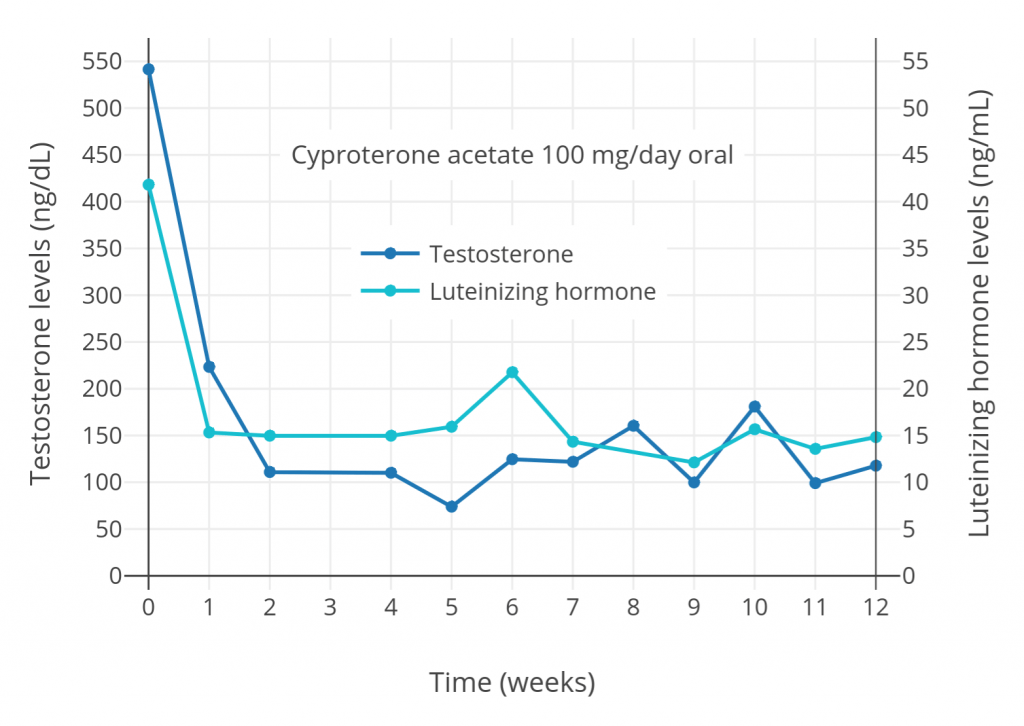
Việc ức chế nồng độ Testosterone của CPA chứng minh rõ ràng nó hoạt động như 1 chất kháng Androgens, việc kết hợp Estrogens và CPA có thể ức chế tối đa nồng độ của Testosterone.
Tác dụng phụ của CPA là có nguy cơ gây tăng men gan, và các trường hợp tổn thương gan hiếm gặp, gây huyết khối, và u não. Xét nghiệm theo dõi chức năng gan và nồng độ prolactin được khuyến cáo trong quá trình điều trị bằng CPA. Để hạn chế tác dụng phụ có thể sử dụng CPA với liều thấp nhất trong khi vẫn có tác dụng trong việc kháng Androgens, liều như vậy thấp hơn nhiều so với liều thường được sử dụng trong lâm sàng. Có 1 điều cần lưu ý là CPA không được cấp phép cho sử dụng tại Hoa Kỳ, nhưng được phép ở một số quốc gia khác.
Thuốc ức chế 5α-Reductase
5α-RIs hoạt động bằng cách ngăn chặn Testosterone chuyển hóa thành dihydrotestosterone (DHT), 1 chất mạnh hơn rất nhiều lần ở trong các mô cụ thể như da, nang lông và tuyến tiền liệt. Vì vậy nên hiệu quả kháng Androgens của nó chỉ giới hạn trong điều trị rụng tóc,mọc lông quá mức trên khuôn mặt hoặc cơ thể, và phì đại tuyến tiền liệt à chúng không phù hợp để làm thuốc kháng Androgens ở người chuyển giới nữ vì có ít hoặc không có ảnh hướng đến tác dụng của Testosterone ở các bộ phận khác trong cơ thể.
Thuốc đồng vận và đối vận GnRH
Các chất đồng vận GnRH và chất đối vận GnRH hoạt động bằng việc chặn hoàn toàn tác dụng của GnRH, do đó ngưng hoàn toàn việc sản xuất ra các hormone sinh dục ở tuyến sinh dục. Nó giống y hệt việc thiến sinh học nhưng có thể đảo ngược quá trình khi ngưng thuốc, và là thuốc kháng Androgens lý tưởng cho người chuyển giới nữ. Không may là nó có giá rất đắt có thể lên đến hơn 200,000,000 VND/năm. Với điều kiện sử dụng kết hợp với Estrogens để ngăn ngừa việc thiếu hụt hormone sinh dục thì chất đồng vận GnRH và chất đối vận GnRH về cơ bản rất tít tác dụng phụ hoặc nguy cơ.
Androgens
Testosterone trong một số trường hợp có thể được chỉ định dùng khi nồng độ Testosterone của cá nhân đó xuống quá thấp, nó mang lại một số lợi ích khi được giữ cân bằng ở phạm vi của nữ như tăng ham muốn tình dục, cải thiện tâm trạng và năng lượng, tác động tích cực đến sức khỏe làn da.
Đường dùng thuốc, Liều lượng và nồng độ
Estrogens, Progestogens, và Antiandrogens có sẵn ở nhiều dạng và bằng nhiều đường sử dụng khác nhau. Đường dùng thuốc có thể ảnh hưởng đến sự hấp thụ, phân phối, chuyển hóa và thải trừ hormone trong cơ thể, dẫn đến sự khác biệt rất nhiều giữa các đường dùng thuốc về sinh khả dụng, nồng độ hormone trong máu và các mô cụ thể, hoặc các chất chuyển hóa, các chất này có thể có ý nghĩa khi điều trị.
| Đường dùng thuốc | Viết tắt | Miêu tả cách dùng | Dạng điển hình |
| Đường uống | PO | Nuốt | Viên nén, viên nhộng |
| Đặt dưới lưỡi | SL | Đặt thuốc và hấp thụ dưới lưỡi | Viên nén |
| Đặt trong má | BUC | Đặt và hấp thụ tại má trong hoặc dưới lợi | Viên nén |
| Xuyên da | TD | Bôi và hấp thụ xuyên qua da | Miếng dán, gel, kem bôi |
| Đường trực tràng | REC | Đút và hấp thụ trong lỗ hậu môn | Viên đạn |
| Tiêm bắp | IM | Tiêm vào bắp (ví dụ: mông, đùi, cánh tay) | Dung dịch (Lọ) |
| Tiêm dưới da | SC | Tiêm vào lớp mỡ dưới da | Dung dịch (Lọ) |
| Cấy dưới da | SCi | Cấy vào lớp mỡ dưới da thông qua đường rạch phẫu thuật | Pellet |
Đặt thuốc tại âm đạo là một đường dùng thuốc chính ở phụ nữ hợp giới chứ không phải những phụ nữ chuyển giới. Niêm mạc của “âm đạo giả” không phải là biểu mô như của phụ nữ hợp giới mà là da hoặc ruột kết tùy thuộc loại phẫu thuật âm đạo được thực hiện (Tạo hình âm đạo đảo ngược da dương vật hoặc dùng đại tràng sigma). Vì lý do này, việc sử dụng qua đường âm đạo ở những người chuyển giới có đặc tính giống với đường dùng qua da hoặc trực tràng.
Estradiol
Estradiol và các este của nó thường được sử dụng bằng các đường uống, đặt dưới lưỡi, bôi da, tiêm bắp hoặc tiêm dưới da.
Estradiol đường uống được bán dưới dạng viên nén chứa Estradiol hoặc viên nén chứa Estradiol valerate. Sử dụng Estradiol bằng đường uống thường gặp vấn đề về sinh khả dụng rất thấp và thường chỉ đạt mức nồng độ Estradiol thấp. Dẫn đến hạn chế hiệu quả của nó và không thể ức chế mức Testosterone đầy đủ (Wiki; Leinung et al., 2018; Leinung, 2014). Để khắc phục, có thể đặt thuốc dưới lưỡi thay vì uống. Sinh khả dụng khi đặt dưới lưỡi tăng cao gấp 5 lần so với khi dùng đường uống (Wiki). Tuy nhiên thời gian bán thải khi đặt dưới lưỡi rất ngắn (Wiki), vì lý do đó có thể dùng chia làm nhiều lần trong ngày nhằm mục đích duy trì nồng độ Estradiol ổn định hơn. Khi đặt thuốc trong má cũng cho tác dụng tương tự như khi đặt dưới lưỡi nhưng thường ít được sử dụng vì khá bất tiện (Wiki).
Miếng dán Estradiol xuyên da cũng được sử dụng, và thường cần 2-4 miếng dán khi đơn trị liệu(monotherapy) để đạt được mức nồng độ Estradiol đủ cao nhằm mục đích ức chế tối đa Testosterone. Tương tự với gel bôi Estradiol, khi đơn trị liệu cũng cần bôi với liều lượng lớn. Ngoại trừ trường hợp bôi vào da bìu dái hoặc vùng da ở mép “âm đạo giả”, khi bôi vào vùng này cho nồng độ Estradiol cao hơn rất nhiều khi bôi vào vùng da cánh tay, da bụng, hoặc da bẹn,…
Đối với Estradiol este dạng tiêm ví dụ như Estradiol valerate, Estradiol Benzoate,… Có thể tiêm bắp hoặc tiêm dưới da. Thường thì tiêm dưới da sẽ dễ dàng, thuận tiện và ít đau đớn, được ưa chuộng hơn so với khi tiêm vào bắp. Estradiol este dạng tiêm dễ dàng cho mức nồng độ Estradiol rất cao. Tùy thuộc vào loại Estradiol este được sử dụng, hiệu lực có thể kéo dài từ vài ngày đến vài tuần.
Đường tiêm, xuyên da mặc dù kém thuận tiện hơn so với đường uống, nhưng thường được ưu tiên hơn. Vì đường uống phải qua pha chuyển hóa đầu tiên tại gan, sẽ gây ra nồng độ Estradiol trong gan cao do đó tác động không cân xứng đến quá trình điều biến protein tại gan (Wiki). Đặc biệt khi sử dụng đường uống với liều cao ở người chuyển giới sẽ gây ra các tác dụng phụ như hình thành huyết khối tĩnh mạch sâu, tăng nguy cơ các bệnh tim mạch. Những tác dụng phụ này phần lớn sẽ được loại bỏ khi sử dụng Estradiol đường tiêm hoặc xuyên da với liều lượng hợp lý.
| Thuốc | Đường dùng thuốc | Dạng | Liều lượng |
| Estradiol | Đường uống | Viên nén | 2-10 mg/ngày (Miligram) |
| Đặt dưới lưỡi, đặt trong má | Viên nén | 0.5-2 mg mỗi lần, 1-4 lần/ngày | |
| Xuyên da | Miếng dán | 50–300 μg/ngày (microgram) | |
| Xuyên da | Gel | 2-6 mg/ngày | |
| Cấy dưới da | Pellet | 25-150 mg/ 6 tháng | |
| Estradiol Valerate | Đường uống | Viên nén | 2-10 mg/ngày |
| Đặt dưới lưỡi, đặt trong má | Viên nén | 0.5-2 mg mỗi lần, 1-4 lần/ngày | |
| Tiêm bắp, tiêm dưới da | Dung dịch dầu | 2–6 mg/tuần; hoặc 1.5–4 mg/ 5 ngày | |
| Estradiol Cypionate | Tiêm bắp, tiêm dưới da | Dung dịch dầu | 2–6 mg/tuần |
| Estradiol Benzoate | Tiêm bắp, tiêm dưới da | Dung dịch dầu | 1–3 mg mỗi lần, 2 lần/tuần |
| Estradiol Enanthate | Tiêm bắp, tiêm dưới da | Dung dịch dầu | 4–12 mg/ 2 tuần |
| Polyestradiol Phosphate | Tiêm bắp | Dung dịch nước | 40–160 mg/tháng |
Tham khảo từ nguồn: Wikipedia: Estradiol (medication)
- Với đường uống, 1.5 mg Estradiol tương đương với 2mg Estradiol valerate (Wiki).
- Dựa trên nghiên cứu, sinh khả dụng khi đặt dưới lưỡi cao hơn khi uống từ 2-5 lần (Wiki).
- Liều cho nồng độ tương đương sẽ thấp hơn nhiều khi bôi vào da bìu
- Tùy thuộc vào loại estradiol este dùng khi tiêm
Có sự khác biệt cao về nồng độ estradiol đạt được giữa các cá nhân trong quá trình điều trị bằng estradiol. Có nghĩa là, nồng độ estradiol trong khi điều trị với cùng một liều lượng estradiol có thể khác nhau rất nhiều giữa các cá nhân, không ai giống ai. Sự khác biệt này lớn nhất đối với đường uống và qua da. Do đó, liều lượng khuyến cáo không phải là tuyệt đối và nên được điều chỉnh riêng lẻ kết hợp với xét nghiệm máu trong từng trường hợp cụ thể. Cũng cần lưu ý rằng nồng độ estradiol có thể thay đổi đáng kể giữa lần xét nghiệm này và lần xét nghiệm khác, nhất là với đường đặt dưới lưỡi và đường tiêm. Tuy nhiên, sự biến đổi này có thể dự đoán được.
Sau khi cắt bỏ tinh hoàn (lúc này không còn mục đích phải ức chế Testosterone), liều lượng estrogen có thể được hạ xuống nhiều để gần giống nhất với mức sinh lý bình thường của phụ nữ hợp giới. Sản lượng trung bình của estradiol ở phụ nữ tiền mãn kinh là khoảng 6 mg/chu kỳ kinh nguyệt (tức là một tháng) (Rosenfield et al., 2008).
Progesterone và Progestins
Progesterone và Progestins đều có hoạt động Progestogenic qua đó có hiệu ứng Antigonadotropic (ức chế giải phóng Gonadotropin) nên được sử dụng làm thuốc ức chế Testosterone.
Progesterone có thể được dùng qua đường uống, đường trực tràng hoặc tiêm vào bắp thịt hoặc tiêm dưới da. Nồng độ Progesterone khi dùng đường uống được đo bằng phương pháp xét nghiệm (LC–MS) là rất thấp (<2 ng/dL ở liều lượng 100 mg/ngày) và không đủ để đạt những hiệu ứng mong đợi của Progestogen. Do đó, ngay cả khi sử dụng Progesterone đường uống ở liều cao cũng cho thấy hiệu quả rất kém, không có hiệu ứng Antigonadotropic (Ức chế giải phóng Gonadotropin), điều này đối nghịch rất lớn Progesterone đường tiêm, đặt trực tràng. Ngoài ra, Progesterone qua đường uống cũng bị chuyển đổi quá mức (>90%) thành các chất chuyển hóa Neurosteroid mức độ mạnh như Allopregnanolone, dẫn đến hậu quả là gặp các tác dụng phụ giống nhiễm độc cồn như là say rượu, suy giảm nhận thức/trí nhớ, và tâm trạng thay đổi thất thường. Chính vì vậy, việc dùng Progesterone với đường tiêm được ưa chuộng hơn, mặc dù bất tiện. Progesterone đường tiêm có hiệu quả tương đối ngắn và phải tiêm từ 1-3 ngày/lần, Điều này làm cho nó quá bất tiện để sử dụng cho hầu hết mọi người.
Ngoài ra, Progesterone có thể sử dụng qua đường trực tràng dưới hình thức dạng viên đạn, tên thuốc là Cyclogest. Mang lại hiệu quả cao hơn nhiều so với đường uống, thuận tiện hơn so với đường tiêm khi không phải tiêm, mặc dù chắc chắn là sẽ bất tiện khi sử dụng do phải nhét vào lỗ hậu môn, nhưng đây có lẽ là đường dùng Progesterone tốt nhất cho người chuyển giới.
Ngược lại, Progestins khi dùng đường uống lại có sinh khả dụng rất cao, vì Progestins đối kháng chuyển hóa tại gan, và thụ thể Progestogens biểu hiện rất ít tại gan. Do đó, Progestins lại có thể được sử dụng bằng đường uống và nó cũng là đường dùng Progestins phổ biến nhất, mà không gặp vấn đề gì về tác dụng.
- Progestins đường uống tiêu biểu chính là Cyproterone Acetate được bán dưới tên Androcur
- Progestins dạng tiêm ở Việt Nam thường là Hydroxyprogesterone caproate (OHPC) được bán dưới tên Proluton, thời gian đào thải từ vài tuần đến vài tháng.
| Thuốc | Đường dùng thuốc | Dạng | Liều lượng |
| Progesterone | Đường uống | Viên nang dầu | 100-300 mg mỗi lần, 1-2 lần/ngày |
| Đường trực tràng | Viên đạn, Viên nang dầu | 100-200 mg mỗi lần, 1-2 lần/ngày | |
| Tiêm bắp | Dung dịch dầu | 25-75 mg/ 1-3 ngày | |
| Tiêm dưới da | Dung dịch nước | 25 mg/ngày | |
| Progestins | Đường uống, tiêm bắp, tiêm dưới da | Viên nén, dung dịch dầu, dung dịch nước | Nhiều liều lượng |
Tham khảo từ nguồn: Wikipedia: Progesterone (medication)
Như với estradiol, có sự khác biệt cao giữa các cá nhân về mức nồng độ progesterone. Ngược lại, hầu như không có sự khác biệt giữa các cá nhân trong trường hợp progestin.
Sau khi cắt bỏ tinh hoàn, liều progestogen có thể giảm xuống hoặc có thể ngừng hoàn toàn.
Đối kháng thụ thể Androgens và Cyproterone Acetate
Các thuốc đối kháng thụ thể Androgens và Cyproterone Acetate thường được sử dụng qua đường uống dưới dạng viên nén.
| Thuốc | Loại | Đường dùng thuốc | Dạng | Liều lượng |
| Spironolactone | Đối kháng thụ thể Androgens | Đường uống | Viên nén | 100-200 mg mỗi lần, 1-2 lần/ngày (a) |
| Bicalutamide | Đối kháng thụ thể Androgens | Đường uống | Viên nén | 12.5 - 50 mg/ngày |
| Cyproterone Acetate (CPA) | Progestogen, Đối kháng thụ thể Androgens | Đường uống | Viên nén | 2.5–12.5 mg/ngày (b) |
(a) Với các thuốc thuần đối kháng thụ thể androgens như Spironolactone và Bicalutamide, liều cao hơn có thể được chỉ định nếu nồng độ Testosterone >200 ng/dL
(b) Với CPA, một phần tư của viên 10mg -> 1 viên 10mg (2.5-10 mg/ngày) hoặc 1 phần tư của viên 50mg (12.5 mg/ngày), vì CPA bán thải chậm. Liều từ 5-12.5mg/ngày là quá đủ để ức chế tối đa nồng độ Testosterone trong khi liều cao hơn là thừa thãi, nguy hiểm và làm tăng nguy cơ gặp tác dụng phụ bất lợi. Bắt buộc phải sử dụng dưới sự giám sát của bác sĩ.
Tài liệu tham khảo: Cyproterone acetate | Spironolactone | Bicalutamide
Thuốc ức chế enzym 5α-Reductase
Thuốc ức chế enzym 5α-Reductase được sử dụng bằng đường uống dưới dạng viên nén hoặc viên nhộng.
| Thuốc | Đường dùng thuốc | Dạng | Liều lượng |
| Dutasteride | Đường uống | Viên nhộng | 0.5 mg/ngày |
| Finastereide | Đường uống | Viên nén | 0.25-5 mg/ngày |
Tài liệu tham khảo: Dutasteride | Finasteride
Thuốc đồng vận GnRH
Thuốc đồng vận GnRH được tiêm bắp hoặc tiêm dưới da mỗi ngày, hoặc mỗi tháng (tùy liều lượng). Ngoài ra có thể được cấy dưới da mỗi năm một lần hoặc sử dụng dưới dạng xịt mũi (Nasal Spray) hai đến ba lần mỗi ngày
| Hoạt chất | Tên thuốc | Đường dùng thuốc | Dạng | Liều lượng |
| Goserelin | Zoladex | Tiêm dưới da | Cấy phóng thích chậm | 3,6 mg/tháng |
| Leuprorelin | Eligard, Lucrin PDS, Luphere | Tiêm dưới da | Bột pha tiêm, Bột pha hỗn dịch tiêm, hỗn dịch tiêm | 3,75–7,5 mg/tháng |
| 11.25–22.5 mg/3 tháng | ||||
| 30 mg/4 tháng | ||||
| 45 mg/6 tháng | ||||
| Triptorelin pamoate | Diphereline P.R | Tiêm dưới da | Bột và dung môi pha hỗn dịch tiêm, dạng phóng thích kéo dài | Nhiều liều lượng |
| Triptorelin (dưới dạng Triptorelin acetat) | Diphereline | Tiêm dưới da | Bột pha tiêm | 0.1 mg/ 1-7 ngày; 3.75 mg/tháng |
Dạng thuốc này rất đắt và rất khó tiếp cận tại Việt Nam.
Thuốc đối vận GnRH
Các thuốc đối vận GnRH được phát triển để sử dụng bằng cách tiêm bắp hoặc tiêm dưới da mỗi tháng một lần
Theo Dõi Trong Quá Trình Điều trị
Người chuyển giới nữ đang trong quá trình điều trị liệu pháp hormone nên được thực hiện kiểm tra cận lâm sàng định kỳ dưới hình thức xét nghiệm máu để đánh giá hiệu quả và theo dõi tính an toàn. Nồng độ Estradiol toàn phần và Testosterone toàn phần cần được đo lường để đánh giá hiệu quả của liệu pháp, mục đích để xem liệu nồng độ hormone có nằm trong khoảng sinh lý của nữ hợp giới (Cisgender Females) hay không và xác định xem có cần điều chỉnh liều lượng thuốc hay không. Nồng độ Testosterone tự do, Estradiol tự do, Estrone (E1), Dihydrotestosterone (DHT), Luteinizing Hormone (LH), Follicle Stimulating Hormone (FSH), và Sex Hormone Binding Globulin (SHBG) cũng có thể được đo để cung cấp thêm thông tin, mặc dù chúng không hoàn toàn bắt buộc. Nếu Progesterone được sử dụng như một phần của phác đồ, nồng độ Progesterone có thể được đo để đánh giá mức độ phơi nhiễm Progesterone. Bên cạnh các xét nghiệm máu để kiểm tra hormone, người chuyển giới nữ có thể theo dõi các thay đổi về thể chất của họ trong quá trình điều trị nội tiết, chẳng hạn như sự phát triển của ngực và các khía cạnh nữ tính hóa khác, bằng cách sử dụng các phương pháp đo lường thể chất và kỹ thuật số khác nhau (ví dụ: Wiki).
Ở những người chuyển giới nữ đang sử dụng bicalutamide hoặc CPA liều cao (≥20 mg/ngày), các xét nghiệm chức năng gan (LFTs), chẳng hạn như nồng độ Aspartate Transaminase (AST) và Alanine Transaminase (ALT), cần được thực hiện định kỳ để theo dõi độc tính trên gan. Đối với những người đang sử dụng spironolactone và có các yếu tố nguy cơ liên quan đến tăng kali máu (nồng độ kali trong máu cao), chẳng hạn như lớn tuổi, suy giảm chức năng thận, hoặc sử dụng đồng thời các thuốc làm tăng kali hoặc các chất bổ sung kali, nồng độ kali cần được theo dõi định kỳ để đánh giá tình trạng tăng kali máu. Ngược lại, ở những người trẻ tuổi khỏe mạnh không có các yếu tố nguy cơ này đang sử dụng spironolactone, việc theo dõi nồng độ kali dường như mang lại lợi ích hạn chế (Plovanich, Weng, & Mostaghimi, 2015; Zaenglein et al., 2016; Layton et al., 2017; Millington, Liu, & Chan, 2019; Wang & Lipner, 2020; Gupta et al., 2022; Hayes et al., 2022). Ở những người chuyển giới nữ sử dụng liều cao Estrogen hoặc Progestogen, đặc biệt là CPA, nồng độ Prolactin cần được đo lường định kỳ để theo dõi tình trạng tăng prolactin máu (nồng độ prolactin trong máu cao) và u tuyến yên tiết Prolactin (prolactinoma) (Callen-Lorde, 2018; Iwamoto et al., 2019). Ở những người sử dụng CPA liều cao (>12,5 mg/ngày), nên thực hiện chụp cộng hưởng từ (MRI) định kỳ để theo dõi sự phát triển của u màng não (meningiomas) (Aly, 2020). Nếu các cận lâm sàng nêu trên cho kết quả bất thường, tùy thuộc vào tình huống và mức độ nghiêm trọng, liều lượng thuốc nên được giảm xuống hoặc phải ngừng các thuốc cụ thể hoặc thay thế bằng các phương pháp khác.
Một số tình huống điều trị nhất định có thể dẫn đến kết quả xét nghiệm máu không chính xác. Việc theo dõi nồng độ Progesterone khi sử dụng Progesterone đường uống bằng các xét nghiệm máu dựa trên phương pháp miễn dịch (immunoassay-based) có thể dẫn đến kết quả nồng độ Progesterone cao giả do phản ứng chéo với nồng độ cao của các chất chuyển hóa Progesterone như allopregnanolone (Aly, 2018; Wiki). Thay vì các xét nghiệm dựa trên phương pháp miễn dịch, nên sử dụng các xét nghiệm dựa trên phương pháp sắc ký khối phổ (mass spectrometry-based) để xác định chính xác nồng độ progesterone khi dùng progesterone đường uống (Aly, 2018; Wiki). Ngược lại, cả hai loại xét nghiệm đều có thể được sử dụng để đo nồng độ Progesterone đối với liệu pháp Progesterone không qua đường uống. Việc bổ sung Biotin (vitamin B7) liều cao có thể tác động vào độ chính xác của các xét nghiệm máu kiểm tra hormone dựa trên phương pháp miễn dịch, gây ra các kết quả thấp giả hoặc cao giả (Samarasinghe et al., 2017; Avery, 2019; Bowen et al., 2019; FDA, 2019; Luong, Male, & Glennon, 2019). Các dạng bào chế estradiol thẩm thấu qua da (transdermal) được bôi lên cánh tay có thể gây ngoại nhiễm mẫu máu được lấy từ chính cánh tay đó, dẫn đến kết quả nồng độ estradiol cao giả (Vihtamäkia, Luukkaala, & Tuimala, 2004).
Một số loại ung thư được biết đến là nhạy cảm với hormone và tỷ lệ mắc phải chúng có thể bị ảnh hưởng bởi liệu pháp hormone. Tầm soát ung thư vú và ung thư tuyến tiền liệt được khuyến cáo cho những người chuyển giới nữ (Sterling & Garcia, 2020; Iwamoto et al., 2021). Nguy cơ ung thư vú dường như tăng lên đáng kể khi sử dụng liệu pháp hormone nữ hoá, đặc biệt là khi sử dụng với Progestogen (Aly, 2020). Tuy nhiên, nguy cơ này vẫn thấp hơn so với phụ nữ hợp giới (Aly, 2020). Tỷ lệ mắc ung thư tuyến tiền liệt giảm mạnh khi áp dụng liệu pháp hormone nữ hoá do hệ quả của việc triệt tiêu androgen (androgen deprivation), nhưng nguy cơ này không bị loại bỏ hoàn toàn và ung thư tuyến tiền liệt vẫn có thể xảy ra (de Nie et al., 2020). Một điều cần phải lưu ý là Tuyến tiền liệt không bị cắt bỏ khi phẫu thuật tạo hình âm đạo (vaginoplasty), vì vậy những người chuyển giới nữ đã trải qua phẫu thuật tạo hình âm đạo vẫn cần được tiếp tục theo dõi ung thư tuyến tiền liệt. Ung thư tinh hoàn không được biết đến là một loại ung thư phụ thuộc vào hormone và tỷ lệ mắc phải dường như không tăng lên khi sử dụng liệu pháp hormone nữ hoá (Bensley et al., 2021; de Nie et al., 2021; Jacoby et al., 2021).
Tài liệu tham khảo
Tài liệu này đã được dịch và chỉnh sửa cho phù hợp hoàn cảnh tại Việt Nam dưới sự cho phép trực tiếp từ Aly W. của TransfemScience.
Nguồn: (Aly W., 2018)/Transfeminine Science
- Abbott Laboratories. (2009). Estradiol. Architect System. Abbott Park, Illinois/Wiesbaden, Germany: Abbott Laboratories. [PDF]
- Ahmad, S. R., & Graham, D. J. (2003). Pneumonitis with Antiandrogens. Annals of Internal Medicine, 139(6), 528–529. [DOI:10.7326/0003-4819-139-6-200309160-00023]
- Allen, A. N., Jiao, R., Day, P., Pagels, P., Gimpel, N., & SoRelle, J. A. (2020). Dynamic Impact of Hormone Therapy on Laboratory Values in Transgender Patients over Time. The Journal of Applied Laboratory Medicine, 6(1), 27–40. [DOI:10.1093/jalm/jfaa192]
- Aly. (2018). A Review of Studies on Spironolactone and Testosterone Suppression in Cisgender Men, Cisgender Women, and Transfeminine People. Transfeminine Science. [URL]
- Aly. (2018). An Introduction to Hormone Therapy for Transfeminine People. Transfeminine Science. [URL]
- Aly. (2018). Buserelin, a Gonadotropin-Releasing Hormone Agonist, is Inexpensively Available as a Nasal Spray From Online Pharmacies. Transfeminine Science. [URL]
- Aly. (2018). EC508 (Estradiol Aminosulfonylbenzoylproline), a Unique and Highly Promising Estradiol Ester and Possible Oral Estradiol Form of the Future. Transfeminine Science. [URL]
- Aly. (2018). Oral Progesterone Achieves Very Low Levels of Progesterone and Has Only Weak Progestogenic Effects. Transfeminine Science. [URL]
- Aly. (2019). A Review of Studies on Estradiol Levels and Testosterone Suppression with High-Dose Transdermal Estradiol Gel and Ointment in Cisgender Men with Prostate Cancer. Transfeminine Science. [URL]
- Aly. (2019). An Exploration of Possibilities for Hormone Therapy in Non-Binary Transfeminine People. Transfeminine Science. [URL]
- Aly. (2019). Analysis of Estradiol and Testosterone Levels with Oral Estradiol in Transfeminine People Based on Leinung et al. (2018). Transfeminine Science. [URL]
- Aly. (2019). Aqueous Suspensions of Sex Hormones and How Depot Injectables Work. Transfeminine Science. [URL]
- Aly. (2019). Genital Application via the Scrotum and Neolabia for Greatly Enhanced Absorption of Transdermal Estradiol in Transfeminine People. Transfeminine Science. [URL]
- Aly. (2019). Literature on Early Progestogen Exposure and Breast Development. Transfeminine Science. [URL]
- Aly. (2019). Low Doses of Cyproterone Acetate Are Maximally Effective for Testosterone Suppression in Transfeminine People. Transfeminine Science. [URL]
- Aly. (2019). Published Case Reports of Lactation and/or Breastfeeding in Transfeminine People. Transfeminine Science. [URL]
- Aly. (2019). Sublingual Administration of Oral Estradiol Valerate Tablets for Transfeminine People. Transfeminine Science. [URL]
- Aly. (2020). A Comprehensive Review of the Potential of Progestogens for Enhancing Breast Development in Transfeminine People. Transfeminine Science. [URL]
- Aly. (2020). Approximate Comparable Dosages of Estradiol by Different Routes. Transfeminine Science. [URL]
- Aly. (2020). Bicalutamide and its Adoption by the Medical Community for Use in Transfeminine Hormone Therapy. Transfeminine Science. [URL]
- Aly. (2020). Breast Cancer Risk with Hormone Therapy in Transfeminine People. Transfeminine Science. [URL]
- Aly. (2020). Clinical Guidelines with Information on Transfeminine Hormone Therapy. Transfeminine Science. [URL]
- Aly. (2020). Estrogens and Their Influences on Coagulation and Risk of Blood Clots. Transfeminine Science. [URL]
- Aly. (2020). Hormone Levels During Normal Puberty in Cisgender Girls. Transfeminine Science. [URL]
- Aly. (2020). Nandrolone as a Potential Alternative Androgen with Reduced Androgenic Side Effects for Transfeminine and Transmasculine People. Transfeminine Science. [URL]
- Aly. (2020). Recent Developments on Cyproterone Acetate and Meningioma Risk Out of France and Implications for Transfeminine People. Transfeminine Science. [URL]
- Aly. (2020). Spironolactone and Claims About Increased Visceral Fat in Transfeminine People. Transfeminine Science. [URL]
- Aly. (2020). The Influence of Progesterone and Other Progestogens on Sexual Desire and Function. Transfeminine Science. [URL]
- Aly. (2020). The Interactions of Sex Hormones with Sex Hormone-Binding Globulin and Relevance for Transfeminine Hormone Therapy. Transfeminine Science. [URL]
- Aly. (2020). The Possible Role of a Second X Chromosome in Breast Cancer Risk. Transfeminine Science. [URL]
- Aly. (2021). An Informal Meta-Analysis of Estradiol Curves with Injectable Estradiol Preparations. Transfeminine Science. [URL]
- Aly. (2021). An Interactive Web Simulator for Estradiol Levels with Injectable Estradiol Esters. Transfeminine Science. [URL]
- Angus, L., Leemaqz, S., Ooi, O., Cundill, P., Silberstein, N., Locke, P., Zajac, J. D., & Cheung, A. S. (2019). Cyproterone acetate or spironolactone in lowering testosterone concentrations for transgender individuals receiving oestradiol therapy. Endocrine Connections, 8(7), 935–940. [DOI:10.1530/ec-19-0272]
- Angus, L. M., Nolan, B. J., Zajac, J. D., & Cheung, A. S. (2020). A systematic review of antiandrogens and feminization in transgender women. Clinical Endocrinology, 94(5), 743–752. [DOI:10.1111/cen.14329]
- Antoniou, T., Gomes, T., Mamdani, M. M., Yao, Z., Hellings, C., Garg, A. X., Weir, M. A., & Juurlink, D. N. (2011). Trimethoprim-sulfamethoxazole induced hyperkalaemia in elderly patients receiving spironolactone: nested case-control study. BMJ, 343, d5228. [DOI:10.1136/bmj.d5228]
- Antoniou, T., Hollands, S., Macdonald, E. M., Gomes, T., Mamdani, M. M., & Juurlink, D. N. (2015). Trimethoprim–sulfamethoxazole and risk of sudden death among patients taking spironolactone. Canadian Medical Association Journal, 187(4), E138–E143. [DOI:10.1503/cmaj.140816]
- Aufrère, M. B., & Benson, H. (1976). Progesterone: An overview and recent advances. Journal of Pharmaceutical Sciences, 65(6), 783–800. [DOI:10.1002/jps.2600650602]
- Avery, G. (2019). Biotin interference in immunoassay: a review for the laboratory scientist. Annals of Clinical Biochemistry: International Journal of Laboratory Medicine, 56(4), 424–430. [DOI:10.1177/0004563219842231]
- Avram, M. M. (2004). Cellulite: a review of its physiology and treatment. Journal of Cosmetic and Laser Therapy, 6(4), 181–185. [DOI:10.1080/14764170410003057]
- Babich, J. S., Kalantar-Zadeh, K., & Joshi, S. (2022). Taking the Kale out of Hyperkalemia: Plant Foods and Serum Potassium in Patients With Kidney Disease. Journal of Renal Nutrition, 32(6), 641–649. [DOI:10.1053/j.jrn.2022.01.013]
- Bäckström, T., Haage, D., Löfgren, M., Johansson, I., Strömberg, J., Nyberg, S., Andréen, L., Ossewaarde, L., van Wingen, G., Turkmen, S., & Bengtsson, S. (2011). Paradoxical effects of GABA-A modulators may explain sex steroid induced negative mood symptoms in some persons. Neuroscience, 191, 46–54. [DOI:10.1016/j.neuroscience.2011.03.061]
- Barbieri, J. S., Margolis, D. J., & Mostaghimi, A. (2021). Temporal Trends and Clinician Variability in Potassium Monitoring of Healthy Young Women Treated for Acne With Spironolactone. JAMA Dermatology, 157(3), 296–296. [DOI:10.1001/jamadermatol.2020.5468]
- Balen, A. H., Conway, G. S., Kaltsas, G., Techatraisak, K., Manning, P. J., West, C., & Jacobs, H. S. (1995). Andrology: Polycystic ovary syndrome: the spectrum of the disorder in 1741 patients. Human Reproduction, 10(8), 2107–2111. [DOI:10.1093/oxfordjournals.humrep.a136243]
- Barrionuevo, P., Nabhan, M., Altayar, O., Wang, Z., Erwin, P. J., Asi, N., Martin, K. A., & Murad, M. H. (2018). Treatment Options for Hirsutism: A Systematic Review and Network Meta-Analysis. The Journal of Clinical Endocrinology & Metabolism, 103(4), 1258–1264. [DOI:10.1210/jc.2017-02052]
- Bazarra-Castro, M. A. (2009). Etiological aspects, therapy regimes, side effects and treatment satisfaction of transsexual patients. (Doctoral dissertation, Ludwig Maximilian University of Munich.) [DOI:10.5282/edoc.9984] [URN:urn:nbn:de:bvb:19-99840] [PDF]
- Belisle, S., & Love, E. J. (1986). Clinical efficacy and safety of cyproterone acetate in severe hirsutism: results of a multicentered Canadian study. Fertility and Sterility, 46(6), 1015–1020. [DOI:10.1016/s0015-0282(16)49873-0]
- Ben Salem, C., Badreddine, A., Fathallah, N., Slim, R., & Hmouda, H. (2014). Drug-Induced Hyperkalemia. Drug Safety, 37(9), 677–692. [DOI:10.1007/s40264-014-0196-1]
- Bensley, J. G., Cheung, A. S., Grossmann, M., & Papa, N. (2022). Testicular Cancer in Trans People Using Feminising Hormone Therapy–A Brief Review. Urology, 160, 1–4. [DOI:10.1016/j.urology.2021.11.014]
- Bessone, F., Lucena, M., Roma, M. G., Stephens, C., Medina-Cáliz, I., Frider, B., Tsariktsian, G., Hernández, N., Bruguera, M., Gualano, G., Fassio, E., Montero, J., Reggiardo, M. V., Ferretti, S., Colombato, L., Tanno, F., Ferrer, J., Zeno, L., Tanno, H., & Andrade, R. J. (2015). Cyproterone acetate induces a wide spectrum of acute liver damage including corticosteroid-responsive hepatitis: report of 22 cases. Liver International, 36(2), 302–310. [DOI:10.1111/liv.12899]
- Boogers, L. S., Sardo Infirri, S. A., Bouchareb, A., Dijkman, B. A., Helder, D., de Blok, C. J., Liberton, N. P., den Heijer, M., van Trotsenburg, A. S., Dreijerink, K. M., Wiepjes, C. M., & Hannema, S. E. (2025). Variations in Volume: Breast Size in Trans Women in Relation to Timing of Testosterone Suppression. The Journal of Clinical Endocrinology & Metabolism, 110(5), e1404–e1410. [DOI:10.1210/clinem/dgae573]
- Bowen, R., Benavides, R., Colón-Franco, J. M., Katzman, B. M., Muthukumar, A., Sadrzadeh, H., Straseski, J., Klause, U., & Tran, N. (2019). Best practices in mitigating the risk of biotin interference with laboratory testing. Clinical Biochemistry, 74, 1–11. [DOI:10.1016/j.clinbiochem.2019.08.012]
- Brown, J., Farquhar, C., Lee, O., Toomath, R., & Jepson, R. G. (2009). Spironolactone versus placebo or in combination with steroids for hirsutism and/or acne. Cochrane Database of Systematic Reviews, 2009(2), CD000194. [DOI:10.1002/14651858.cd000194.pub2]
- Burinkul, S., Panyakhamlerd, K., Suwan, A., Tuntiviriyapun, P., & Wainipitapong, S. (2021). Anti-Androgenic Effects Comparison Between Cyproterone Acetate and Spironolactone in Transgender Women: A Randomized Controlled Trial. The Journal of Sexual Medicine, 18(7), 1299–1307. [DOI:10.1016/j.jsxm.2021.05.003]
- Callen-Lorde Community Health Center. (2018). Protocols for the Provision of Hormone Therapy. New York City: Callen-Lorde Community Health Center. [URL] [PDF]
- Cappelletti, M., & Wallen, K. (2016). Increasing women’s sexual desire: The comparative effectiveness of estrogens and androgens. Hormones and Behavior, 78, 178–193. [DOI:10.1016/j.yhbeh.2015.11.003]
- Carmina, E., Stanczyk, F. Z., & Lobo, R. A. (2019). Evaluation of Hormonal Status. In Strauss, J. F., & Barbieri, R. L. (Eds.). Yen and Jaffe’s Reproductive Endocrinology: Physiology, Pathophysiology, and Clinical Management, 8th Edition (pp. 887–915.e4). Philadelphia: Elsevier. [DOI:10.1016/b978-0-323-47912-7.00034-2]
- Carr, B. R. (1993). The Ovary. In Carr, B. R., & Blackwell, R. E. (Eds.). Textbook of Reproductive Medicine, 1st Edition (pp. 183–207). Norwalk, Connecticut: Appleton & Lange. [Google Scholar] [Google Books] [OpenLibrary] [WorldCat] [Archive.org—2nd edition]
- Carvalho, R. d., Santos, L. D., Ramos, P. M., Machado, C. J., Acioly, P., Frattini, S. C., Barcaui, C. B., Donda, A. L., & Melo, D. F. (2022). Bicalutamide and the new perspectives for female pattern hair loss treatment: What dermatologists should know. Journal of Cosmetic Dermatology, 21(10), 4171–4175. [DOI:10.1111/jocd.14773]
- Chang, J. J., Tran, N. K., Flentje, A., Lubensky, M. E., Obedin-Maliver, J., Lunn, M. R., & Ariel, D. (2024). 12330 Progestogen Experience And Perception Among Transfeminine Adults – A National Survey. Journal of the Endocrine Society, 8(Suppl 1), bvae163.1657. [DOI:10.1210/jendso/bvae163.1657]
- Clark, R. V., Hermann, D. J., Cunningham, G. R., Wilson, T. H., Morrill, B. B., & Hobbs, S. (2004). Marked Suppression of Dihydrotestosterone in Men with Benign Prostatic Hyperplasia by Dutasteride, a Dual 5α-Reductase Inhibitor. The Journal of Clinical Endocrinology & Metabolism, 89(5), 2179–2184. [DOI:10.1210/jc.2003-030330]
- Coleman, E., Radix, A. E., Bouman, W. P., Brown, G. R., de Vries, A. L., Deutsch, M. B., Ettner, R., Fraser, L., Goodman, M., Green, J., Hancock, A. B., Johnson, T. W., Karasic, D. H., Knudson, G. A., Leibowitz, S. F., Meyer-Bahlburg, H. F., Monstrey, S. J., Motmans, J., Nahata, L., … & Arcelus, J. (2022). [World Professional Association for Transgender Health (WPATH)] Standards of Care for the Health of Transgender and Gender Diverse People, Version 8. International Journal of Transgender Health, 23(Suppl 1), S1–S259. [DOI:10.1080/26895269.2022.2100644] [URL] [PDF]
- Collaborative Group on Hormonal Factors in Breast Cancer. (2019). Type and timing of menopausal hormone therapy and breast cancer risk: individual participant meta-analysis of the worldwide epidemiological evidence. The Lancet, 394(10204), 1159–1168. [DOI:10.1016/s0140-6736(19)31709-x]
- Collet, S., Gieles, N. C., Wiepjes, C. M., Heijboer, A. C., Reyns, T., Fiers, T., Lapauw, B., den Heijer, M., & T’Sjoen, G. (2022). Changes in Serum Testosterone and Adrenal Androgen Levels in Transgender Women With and Without Gonadectomy. The Journal of Clinical Endocrinology & Metabolism, 108(2), 331–338. [DOI:10.1210/clinem/dgac576]
- Colonnello, E., Graziani, A., Rossetti, R., Voltan, G., Masi, D., Lubrano, C., Mariani, S., Watanabe, M., Isidori, A. M., Ferlin, A., & Gnessi, L. (2025). The Chronobiology of Hormone Administration: “Doctor, What Time Should I Take My Medication?”. Endocrine Reviews, bnaf013. [DOI:10.1210/endrev/bnaf013]
- Connors, J. M., & Middeldorp, S. (2019). Transgender patients and the role of the coagulation clinician. Journal of Thrombosis and Haemostasis, 17(11), 1790–1797. [DOI:10.1111/jth.14626]
- Cupisti, A., Kovesdy, C., D’Alessandro, C., & Kalantar-Zadeh, K. (2018). Dietary Approach to Recurrent or Chronic Hyperkalaemia in Patients with Decreased Kidney Function. Nutrients, 10(3), 261–261. [DOI:10.3390/nu10030261]
- Cusan, L., Dupont, A., Gomez, J., Tremblay, R. R., & Labrie, F. (1994). Comparison of flutamide and spironolactone in the treatment of hirsutism: a randomized controlled trial. Fertility and Sterility, 61(2), 281–287. [DOI:10.1016/s0015-0282(16)56518-2]
- de Blok, C. J., Wiepjes, C. M., Nota, N. M., van Engelen, K., Adank, M. A., Dreijerink, K. M., Barbé, E., Konings, I. R., & den Heijer, M. (2019). Breast cancer risk in transgender people receiving hormone treatment: nationwide cohort study in the Netherlands. BMJ, 365, l1652. [DOI:10.1136/bmj.l1652]
- de Blok, C. J., Dijkman, B. A., Wiepjes, C. M., Staphorsius, A. S., Timmermans, F. W., Smit, J. M., Dreijerink, K. M., & den Heijer, M. (2021). Sustained Breast Development and Breast Anthropometric Changes in 3 Years of Gender-Affirming Hormone Treatment. The Journal of Clinical Endocrinology & Metabolism, 106(2), e782–e790. [DOI:10.1210/clinem/dgaa841]
- de Nie, I., de Blok, C. J., van der Sluis, T. M., Barbé, E., Pigot, G. L., Wiepjes, C. M., Nota, N. M., van Mello, N. M., Valkenburg, N. E., Huirne, J., Gooren, L. J., van Moorselaar, R. J., Dreijerink, K. M., & den Heijer, M. (2020). Prostate Cancer Incidence under Androgen Deprivation: Nationwide Cohort Study in Trans Women Receiving Hormone Treatment. The Journal of Clinical Endocrinology & Metabolism, 105(9), e3293–e3299. [DOI:10.1210/clinem/dgaa412]
- de Nie, I., Wiepjes, C. M., Blok, C. J., Moorselaar, R. J., Pigot, G. L., Sluis, T. M., Barbé, E., Voorn, P., Mello, N. M., Huirne, J., & Heijer, M. (2021). Incidence of testicular cancer in trans women using gender‐affirming hormonal treatment: a nationwide cohort study. BJU International, 129(4), 491–497. [DOI:10.1111/bju.15575]
- Deng, T., Duan, X., He, Z., Zhao, Z., & Zeng, G. (2020). Association Between 5-Alpha Reductase Inhibitor Use and The Risk of Depression: A Meta-Analysis. Urology Journal, 18(2), 144–150. [DOI:10.22037/uj.v16i7.5866]
- Deutsch, M. B. (2016). Overview of feminizing hormone therapy. In Deutsch, M. B. (Ed.). Guidelines for the Primary and Gender-Affirming Care of Transgender and Gender Nonbinary People, 2nd Edition (pp. 26–48). San Francisco: University of California, San Francisco/UCSF Transgender Care. [URL] [PDF]
- Dewhurst, J., & Underhill, R. (1979). The Suppression of Facial Hair Growth in Transsexuals Using Cyproterone Acetate. British Journal of Sexual Medicine, 6, 19–23. [Google Scholar] [PDF]
- Dhurat, R., Sharma, A., Rudnicka, L., Kroumpouzos, G., Kassir, M., Galadari, H., Wollina, U., Lotti, T., Golubovic, M., Binic, I., Grabbe, S., & Goldust, M. (2020). 5‐Alpha reductase inhibitors in androgenetic alopecia: Shifting paradigms, current concepts, comparative efficacy, and safety. Dermatologic Therapy, 33(3), e13379. [DOI:10.1111/dth.13379]
- Drake, L., Hordinsky, M., Fiedler, V., Swinehart, J., Unger, W. P., Cotterill, P. C., Thiboutot, D. M., Lowe, N., Jacobson, C., Whiting, D., Stieglitz, S., Kraus, S. J., Griffin, E. I., Weiss, D., Carrington, P., Gencheff, C., Cole, G. W., Pariser, D. M., Epstein, E. S., Tanaka, W., Dallob, A., Vandormael, K., Geissler, L., & Waldsteicher, J. (1999). The effects of finasteride on scalp skin and serum androgen levels in men with androgenetic alopecia. Journal of the American Academy of Dermatology, 41(4), 550–554. [DOI:10.1016/s0190-9622(99)80051-6]
- Dyson, T. E., Cantrell, M. A., & Lund, B. C. (2020). Lack of Association between 5α-Reductase Inhibitors and Depression. Journal of Urology, 204(4), 793–798. [DOI:10.1097/ju.0000000000001079]
- Erem, C. (2013). Update on idiopathic hirsutism: diagnosis and treatment. Acta Clinica Belgica, 68(4), 268–274. [DOI:10.2143/acb.3267]
- Erenus, M., Gürbüz, O., Durmuşoğlu, F., Demirçay, Z., & Pekin, S. (1994). Comparison of the efficacy of spironolactone versus flutamide in the treatment of hirsutism. Fertility and Sterility, 61(4), 613–616. [DOI:10.1016/s0015-0282(16)56634-5]
- Esoterix/LabCorp. (2020). Endocrinology Expected Values and S.I. Unit Conversion Tables. LabCorp/Endocrine Sciences. [PDF]
- Even Zohar, N., Sofer, Y., Yaish, I., Serebro, M., Tordjman, K., & Greenman, Y. (2021). Low-Dose Cyproterone Acetate Treatment for Transgender Women. The Journal of Sexual Medicine, 18(7), 1292–1298. [DOI:10.1016/j.jsxm.2021.04.008]
- Fertig, R., Shapiro, J., Bergfeld, W., & Tosti, A. (2016). Investigation of the Plausibility of 5-Alpha-Reductase Inhibitor Syndrome. Skin Appendage Disorders, 2(3–4), 120–129. [DOI:10.1159/000450617]
- Food and Drug Administration. (2019). UPDATE: The FDA Warns that Biotin May Interfere with Lab Tests: FDA Safety Communication. Food and Drug Administration. [URL]
- Fournier, A., Berrino, F., & Clavel-Chapelon, F. (2007). Unequal risks for breast cancer associated with different hormone replacement therapies: results from the E3N cohort study. Breast Cancer Research and Treatment, 107(1), 103–111. [DOI:10.1007/s10549-007-9523-x]
- Frye, S. (2006). Discovery and Clinical Development of Dutasteride, a Potent Dual 5α-Reductase Inhibitor. Current Topics in Medicinal Chemistry, 6(5), 405–421. [DOI:10.2174/156802606776743101]
- Gava, G., Mancini, I., Alvisi, S., Seracchioli, R., & Meriggiola, M. C. (2020). A comparison of 5-year administration of cyproterone acetate or leuprolide acetate in combination with estradiol in transwomen. European Journal of Endocrinology, 183(6), 561–569. [DOI:10.1530/eje-20-0370]
- Getzenberg, R., & Itty, S. (2020). How do we define “castration” in men on androgen deprivation therapy? Asian Journal of Andrology, 22(5), 441–446. [DOI:10.4103/aja.aja_139_19]
- Giltay, E. J., Gooren, L. J., Toorians, A. W., Katan, M. B., & Zock, P. L. (2004). Docosahexaenoic acid concentrations are higher in women than in men because of estrogenic effects. The American Journal of Clinical Nutrition, 80(5), 1167–1174. [DOI:10.1093/ajcn/80.5.1167]
- Glintborg, D., T’Sjoen, G., Ravn, P., & Andersen, M. S. (2021). MANAGEMENT OF ENDOCRINE DISEASE: Optimal feminizing hormone treatment in transgender people. European Journal of Endocrinology, 185(2), R49–R63. [DOI:10.1530/eje-21-0059]
- Goletiani, N. V., Keith, D. R., & Gorsky, S. J. (2007). Progesterone: Review of safety for clinical studies. Experimental and Clinical Psychopharmacology, 15(5), 427–444. [DOI:10.1037/1064-1297.15.5.427]
- Goodfellow, A., Alaghband-Zadeh, J., Carter, G., Cream, J., Holland, S., Scully, J., & Wise, P. (1984). Oral spironolactone improves acne vulgaris and reduces sebum excretion. British Journal of Dermatology, 111(2), 209–214. [DOI:10.1111/j.1365-2133.1984.tb04045.x]
- Gooren, L. J. (2016). The Endocrinology of Sexual Behavior and Gender Identity. In Jameson, J. L., & De Groot, L. J. (Eds.). Endocrinology: Adult and Pediatric, 7th Edition, Volume 2 (pp. 2163–2176.e4). Philadelphia: Saunders/Elsevier. [Google Books] [DOI:10.1016/B978-0-323-18907-1.00124-4]
- Gooren, L., & Bunck, M. (2004). Transsexuals and competitive sports. European Journal of Endocrinology, 151(4), 425–429. [DOI:10.1530/eje.0.1510425]
- Gooren, L. J., Harmsen-Louman, W., & Kessel, H. (1985). Follow-up of prolactin levels in long-term oestrogen-treated male-to-female transsexuals with regard to prolactinoma induction. Clinical Endocrinology, 22(2), 201–207. [DOI:10.1111/j.1365-2265.1985.tb01081.x]
- Gooren, L., Rao, B., van Kessel, H., & Harmsen-Louman, W. (1984). Estrogen positive feedback on LH secretion in transsexuality. Psychoneuroendocrinology, 9(3), 249–259. [DOI:10.1016/0306-4530(84)90004-0]
- Gormley, G. J., Stoner, E., Rittmaster, R. S., Gregg, H., Thompson, D. L., Lasseter, K. C., Vlasses, P. H., & Stein, E. A. (1990). Effects of Finasteride (MK-906), a 5α-Reductase Inhibitor, on Circulating Androgens in Male Volunteers. The Journal of Clinical Endocrinology & Metabolism, 70(4), 1136–1141. [DOI:10.1210/jcem-70-4-1136]
- Grock, S., Weinreb, J., Williams, K. C., Weimer, A., Fadich, S., Patel, R., Geft, A., & Korenman, S. (2024). Priorities for efficacy trials of gender-affirming hormone therapy with estrogen: collaborative design and results of a community survey. Hormones, online ahead of print. [DOI:10.1007/s42000-024-00532-3]
- Gubelin Harcha, W., Barboza Martínez, J., Tsai, T., Katsuoka, K., Kawashima, M., Tsuboi, R., Barnes, A., Ferron-Brady, G., & Chetty, D. (2014). A randomized, active- and placebo-controlled study of the efficacy and safety of different doses of dutasteride versus placebo and finasteride in the treatment of male subjects with androgenetic alopecia. Journal of the American Academy of Dermatology, 70(3), 489–498.e3. [DOI:10.1016/j.jaad.2013.10.049]
- Gupta, P., Suppakitjanusant, P., Stevenson, M., Goodman, M., & Tangpricha, V. (2022). Potassium Concentrations in Transgender Women Using Spironolactone: A Retrospective Chart Review. Endocrine Practice, 28(11), 1113–1117. [DOI:10.1016/j.eprac.2022.08.007]
- Hammerstein, J. (1990). Antiandrogens: Clinical Aspects. In Orfanos, C. E., & Happle, R. (Eds.). Hair and Hair Diseases (pp. 827–886). Berlin/Heidelberg: Springer. [DOI:10.1007/978-3-642-74612-3_35]
- Hayes, H., Russell, R., Haugen, A., Nagavally, S., & Sarvaideo, J. (2022). The Utility of Monitoring Potassium in Transgender, Gender Diverse, and Nonbinary Individuals on Spironolactone. Journal of the Endocrine Society, 6(11), bvac133. [DOI:10.1210/jendso/bvac133]
- Heinemann, L. A., Will-Shahab, L., van Kesteren, P., Gooren, L. J., & (1997). Safety of Cyproterone Acetate: Report of Active Surveillance. Pharmacoepidemiology and Drug Safety, 6(3), 169–178. [DOI:10.1002/(sici)1099-1557(199705)6:3<169::aid-pds263>3.0.co;2-3]
- Hembree, W. C., Cohen-Kettenis, P. T., Gooren, L., Hannema, S. E., Meyer, W. J., Murad, M. H., Rosenthal, S. M., Safer, J. D., Tangpricha, V., & T’Sjoen, G. G. (2017). Endocrine Treatment of Gender-Dysphoric/Gender-Incongruent Persons: An Endocrine Society Clinical Practice Guideline. The Journal of Clinical Endocrinology and Metabolism, 102(11), 3869–3903. [DOI:10.1210/jc.2017-01658] [PDF]
- Herndon, J. S., Maheshwari, A. K., Nippoldt, T. B., Carlson, S. J., Davidge-Pitts, C. J., & Chang, A. Y. (2023). Comparison of the Subcutaneous and Intramuscular Estradiol Regimens as Part of Gender-Affirming Hormone Therapy. Endocrine Practice, 29(5), 356–361. [DOI:10.1016/j.eprac.2023.02.006]
- Hilton, E. N., & Lundberg, T. R. (2020). Transgender Women in the Female Category of Sport: Perspectives on Testosterone Suppression and Performance Advantage. Sports Medicine, 51(2), 199–214. [DOI:10.1007/s40279-020-01389-3]
- Hirshburg, J. M., Kelsey, P. A., Therrien, C. A., Gavino, A. C., & Reichenberg, J. S. (2016). Adverse Effects and Safety of 5-alpha Reductase Inhibitors (Finasteride, Dutasteride): A Systematic Review. The Journal of Clinical and Aesthetic Dermatology, 9(7), 56–62. [PubMed] [PubMed Central]
- Hopkins, U., & Arias, C. Y. (2013). Large-volume IM injections: a review of best practices. Oncology Nurse Advisor, 4(1), 32–37. [Google Scholar] [URL] [PDF]
- Horton, R. (1992). Dihydrotestosterone Is a Peripheral Paracrine Hormone. Journal of Andrology, 13(1), 23–27. [DOI:10.1002/j.1939-4640.1992.tb01621.x]
- Huang, G., & Basaria, S. (2017). The Case for Androgens in Menopausal Women: When and How? In Pal, L., & Sayegh, R. A. (Eds.). Essentials of Menopause Management: A Case-Based Approach (pp. 173–196). Cham: Springer International Publishing. [DOI:10.1007/978-3-319-42451-4_10]
- Igo, J., & Visram, H. (2021). Testosterone Suppression With Injectable Estrogen Therapy Alone in Male to Female Transgender Patients. Canadian Journal of Diabetes, 45(7 Suppl), S40–S40 (abstract no. 114). [DOI:10.1016/j.jcjd.2021.09.124] [URL]
- Ingram, B. J., & Thomas, C. L. (2019). Transgender Policy in Sport, A Review of Current Policy and Commentary of the Challenges of Policy Creation. Current Sports Medicine Reports, 18(6), 239–247. [DOI:10.1249/jsr.0000000000000605]
- Irwig, M. S. (2020). Is there a role for 5α‐reductase inhibitors in transgender individuals? Andrology, 9(6), 1729–1731. [DOI:10.1111/andr.12881]
- Iversen, P., Johansson, J. E., Lodding, P., Lukkarinen, O., Lundmo, P., Klarskov, P., Tammela, T. L., Tasdemir, I., Morris, T., Carroll, K., & Scandinavian Prostatic Cancer Group. (2004). Bicalutamide (150 mg) versus placebo as immediate therapy alone or as adjuvant to therapy with curative intent for early nonmetastatic prostate cancer: 5.3-year median followup from the Scandinavian Prostate Cancer Group Study Number 6. The Journal of Urology, 172(5 Part 1), 1871–1876. [DOI:10.1097/01.ju.0000139719.99825.54]
- Iversen, P., Johansson, J., Lodding, P., Kylmälä, T., Lundmo, P., Klarskov, P., Tammela, T. L., Tasdemir, I., Morris, T., Armstrong, J., & (2006). Bicalutamide 150 mg in addition to standard care for patients with early non-metastatic prostate cancer Updated results from the Scandinavian Prostate Cancer Period Group-6 Study after a median follow-up period of 7.1 years. Scandinavian Journal of Urology and Nephrology, 40(6), 441–452. [DOI:10.1080/00365590601017329]
- Iwamoto, S. J., Defreyne, J., Rothman, M. S., Van Schuylenbergh, J., Van de Bruaene, L., Motmans, J., & T’Sjoen, G. (2019). Health considerations for transgender women and remaining unknowns: a narrative review. Therapeutic Advances in Endocrinology and Metabolism, 10, 204201881987116. [DOI:10.1177/2042018819871166]
- Iwamoto, S. J., Grimstad, F., Irwig, M. S., & Rothman, M. S. (2021). Routine Screening for Transgender and Gender Diverse Adults Taking Gender-Affirming Hormone Therapy: a Narrative Review. Journal of General Internal Medicine, 36(5), 1380–1389. [DOI:10.1007/s11606-021-06634-7]
- Jacoby, A., Rifkin, W., Zhao, L. C., & Bluebond-Langner, R. (2020). Incidence of Cancer and Premalignant Lesions in Surgical Specimens of Transgender Patients. Plastic & Reconstructive Surgery, 147(1), 194–198. [DOI:10.1097/prs.0000000000007452]
- Jain, J., Kwan, D., & Forcier, M. (2019). Medroxyprogesterone Acetate in Gender-Affirming Therapy for Transwomen: Results From a Retrospective Study. The Journal of Clinical Endocrinology & Metabolism, 104(11), 5148–5156. [DOI:10.1210/jc.2018-02253]
- James, J. F., Jamerson, T. A., & Aguh, C. (2022). Efficacy and safety profile of oral spironolactone use for androgenic alopecia: A systematic review. Journal of the American Academy of Dermatology, 86(2), 425–429. [DOI:10.1016/j.jaad.2021.07.048]
- Jia, A. Y., & Spratt, D. E. (2022). Bicalutamide Monotherapy With Radiation Therapy for Localized Prostate Cancer: A Non-Evidence-Based Alternative. International Journal of Radiation Oncology*Biology*Physics, 113(2), 316–319. [DOI:10.1016/j.ijrobp.2022.01.037]
- Jiang, Y., & Tian, W. (2017). The effects of progesterones on blood lipids in hormone replacement therapy. Lipids in Health and Disease, 16(1), 219. [DOI:10.1186/s12944-017-0612-5]
- Kanhai, R. C., Hage, J. J., van Diest, P. J., Bloemena, E., & Mulder, J. W. (2000). Short-Term and Long-Term Histologic Effects of Castration and Estrogen Treatment on Breast Tissue of 14 Male-to-Female Transsexuals in Comparison With Two Chemically Castrated Men. The American Journal of Surgical Pathology, 24(1), 74–80. [DOI:10.1097/00000478-200001000-00009]
- Kellner, M., & Wiedemann, K. (2008). Mineralocorticoid receptors in brain, in health and disease: Possibilities for new pharmacotherapy. European Journal of Pharmacology, 583(2–3), 372–378. [DOI:10.1016/j.ejphar.2007.07.072]
- Kim, G. K., & Del Rosso, J. Q. (2012). Oral Spironolactone in Post-teenage Female Patients with Acne Vulgaris: Practical Considerations for the Clinician Based on Current Data and Clinical Experience. The Journal of Clinical and Aesthetic Dermatology, 5(3), 37–50. [PubMed] [PubMed Central]
- King, S. R. (2012). Neurosteroids and the Nervous System. In King, S. R. Neurosteroids and the Nervous System (pp. 1–122). New York: Springer New York. [DOI:10.1007/978-1-4614-5559-2_1]
- Krishnamurthy, N., Slack, D., Kyweluk, M., Kirkley, J., Trakhtenberg, E., Contreras-Castro, F., & Safer, J. (2023). Not All Transfeminine Individuals on Estradiol Can Reach Both Target Testosterone and Target Estradiol Levels—Time to Revisit Treatment Guidelines? USPATH Scientific Symposium, November 1-5, 2023, The Westin Westminster, Westminster, Colorado, Abstract Submissions, 94–94 (abstract no. SAT-B2-T4). [Symposium Schedule] [PDF] [Full Abstract Book]
- Kolvenbag, G. J., & Blackledge, G. R. (1996). Worldwide activity and safety of bicalutamide: a summary review. Urology, 47(1), 70–79. [DOI:10.1016/s0090-4295(96)80012-4]
- Kuhl, H. (2003). Östrogene für den Mann? [Estrogen for men?] Blickpunkt der Mann, 1(3), 6–12. [Google Scholar] [URL] [PDF]
- Kuhl, H. (2005). Pharmacology of estrogens and progestogens: influence of different routes of administration. Climacteric, 8(Suppl 1), 3–63. [DOI:10.1080/13697130500148875] [PDF]
- Kuhl, H., & Wiegratz, I. (2017). Das Post-Finasterid-Syndrom. [Post Finasteride Syndrome.] Gynäkologische Endokrinologie, 15(2), 153–163. [DOI:10.1007/s10304-017-0126-2]
- Kuijpers, S. M., Wiepjes, C. M., Conemans, E. B., Fisher, A. D., T’Sjoen, G., & den Heijer, M. (2021). Toward a Lowest Effective Dose of Cyproterone Acetate in Trans Women: Results From the ENIGI Study. The Journal of Clinical Endocrinology & Metabolism, 106(10), e3936–e3945. [DOI:10.1210/clinem/dgab427]
- Kumar, P., Reddy, S., Kulkarni, A., Sharma, M., & Rao, P. N. (2021). Cyproterone Acetate–Induced Acute Liver Failure: A Case Report and Review of the Literature. Journal of Clinical and Experimental Hepatology, 11(6), 739–741. [DOI:10.1016/j.jceh.2021.01.003]
- Lauritzen, C. (1988). Natürliche und synthetische Sexualhormone – Biologische Grundlagen und Behandlungsprinzipien. [Natural and Synthetic Sexual Hormones – Biological Basis and Medical Treatment Principles.] In Lauritzen, C., Schneider, H. P. G., & Nieschlag, E. (Eds.). Grundlagen und Klinik der Menschlichen Fortpflanzung [Foundations and Clinic of Human Reproduction] (pp. 229–306). Berlin: de Gruyter. [Google Scholar] [Google Books] [OpenLibrary] [WorldCat] [URL] [PDF] [Translation]
- Lax, E. (1987). Mechanisms of physiological and pharmacological sex hormone action on the mammalian liver. Journal of Steroid Biochemistry, 27(4–6), 1119–1128. [DOI:10.1016/0022-4731(87)90198-1]
- Layton, A. M., Eady, E. A., Whitehouse, H., Del Rosso, J. Q., Fedorowicz, Z., & van Zuuren, E. J. (2017). Oral Spironolactone for Acne Vulgaris in Adult Females: A Hybrid Systematic Review. American Journal of Clinical Dermatology, 18(2), 169–191. [DOI:10.1007/s40257-016-0245-x]
- Legro, R. S., Schlaff, W. D., Diamond, M. P., Coutifaris, C., Casson, P. R., Brzyski, R. G., Christman, G. M., Trussell, J. C., Krawetz, S. A., Snyder, P. J., Ohl, D., Carson, S. A., Steinkampf, M. P., Carr, B. R., McGovern, P. G., Cataldo, N. A., Gosman, G. G., Nestler, J. E., Myers, E. R., Santoro, N., Eisenberg, E., Zhang, M., & Zhang, H. (2010). Total Testosterone Assays in Women with Polycystic Ovary Syndrome: Precision and Correlation with Hirsutism. The Journal of Clinical Endocrinology & Metabolism, 95(12), 5305–5313. [DOI:10.1210/jc.2010-1123]
- Leinung, M. C. (2014). Variable Response to Oral Estradiol Therapy in Male to Female Transgender Patients. Endocrine Reviews, 35(Suppl 1) [Endocrine Society’s 96th Annual Meeting and Expo, June 21–24, 2014 – Chicago], ?–? (abstract no. OR42-1). [Google Scholar] [DOI:10.1093/edrv/35.supp.1] [DOI:10.1210/endo-meetings.2014.RE.2.OR42-1] [URL] [MedPage Today]
- Leinung, M. C., Feustel, P. J., & Joseph, J. (2018). Hormonal Treatment of Transgender Women with Oral Estradiol. Transgender Health, 3(1), 74–81. [DOI:10.1089/trgh.2017.0035]
- Liang, J. J., Jolly, D., Chan, K. J., & Safer, J. D. (2018). Testosterone Levels Achieved by Medically Treated Transgender Women in a United States Endocrinology Clinic Cohort. Endocrine Practice, 24(2), 135–142. [DOI:10.4158/ep-2017-0116]
- Lobo, R. A., Shoupe, D., Serafini, P., Brinton, D., & Horton, R. (1985). The effects of two doses of spironolactone on serum androgens and anagen hair in hirsute women. Fertility and Sterility, 43(2), 200–205. [DOI:10.1016/s0015-0282(16)48373-1]
- Loh, H. H., Yee, A., Loh, H. S., Kanagasundram, S., Francis, B., & Lim, L. (2020). Sexual dysfunction in polycystic ovary syndrome: a systematic review and meta-analysis. Hormones, 19(3), 413–423. [DOI:10.1007/s42000-020-00210-0]
- Luong, J. H., Male, K. B., & Glennon, J. D. (2019). Biotin interference in immunoassays based on biotin-strept(avidin) chemistry: An emerging threat. Biotechnology Advances, 37(5), 634–641. [DOI:10.1016/j.biotechadv.2019.03.007]
- MacLean, D. B., Shi, H., Faessel, H. M., & Saad, F. (2015). Medical Castration Using the Investigational Oral GnRH Antagonist TAK-385 (Relugolix): Phase 1 Study in Healthy Males. The Journal of Clinical Endocrinology & Metabolism, 100(12), 4579–4587. [DOI:10.1210/jc.2015-2770]
- Mahler, C. (1996). A Review of the Clinical Studies with Nilutamide. In Denis, L. (Ed.). Antiandrogens in Prostate Cancer: A Key to Tailored Endocrine Treatment (ESO Monographs) (pp. 105–111). Berlin/Heidelberg: Springer Berlin Heidelberg. [DOI:10.1007/978-3-642-45745-6_10]
- Maksym, R. B., Kajdy, A., & Rabijewski, M. (2019). Post-finasteride syndrome – does it really exist? The Aging Male, 22(4), 250–259. [DOI:10.1080/13685538.2018.1548589]
- Marks, D. H., Prasad, S., De Souza, B., Burns, L. J., & Senna, M. M. (2019). Topical Antiandrogen Therapies for Androgenetic Alopecia and Acne Vulgaris. American Journal of Clinical Dermatology, 21(2), 245–254. [DOI:10.1007/s40257-019-00493-z]
- Martinez-Martin, F. J., Kuzior, A., Hernandez-Lazaro, A., de Leon-Durango, R. J., Rios-Gomez, C., Santana-Ojeda, B., Perez-Rivero, J. M., Fernandez-Trujillo-Comenge, P. M., Gonzalez-Diaz, P., Arnas-Leon, C., Acosta-Calero, C., Perdomo-Herrera, E., Tocino-Hernandez, A. L., del Sol Sanchez-Bacaicoa, M., & del Pino Perez-Garcia, M. (2022). Incidence of hypertension in young transgender people after a 5-year follow-up: association with gender-affirming hormonal therapy. Hypertension Research, 46(1), 219–225. [DOI:10.1038/s41440-022-01067-z]
- Masumori, N., Baba, T., Abe, T., & Niwa, K. (2021). What is the most anticipated change induced by treatment using gender‐affirming hormones in individuals with gender incongruence?. International Journal of Urology, 28(5), 526–529. [DOI:10.1111/iju.14499]
- McFarlane, T., Zajac, J. D., & Cheung, A. S. (2018). Gender-affirming hormone therapy and the risk of sex hormone-dependent tumours in transgender individuals—A systematic review. Clinical Endocrinology, 89(6), 700–711. [DOI:10.1111/cen.13835]
- Meriggiola, M. C., Bremner, W. J., Costantino, A., Bertaccini, A., Morselli-Labate, A. M., Huebler, D., Kaufmann, G., Oettel, M., & Flamigni, C. (2002). Twenty-One Day Administration of Dienogest Reversibly Suppresses Gonadotropins and Testosterone in Normal Men. The Journal of Clinical Endocrinology & Metabolism, 87(5), 2107–2113. [DOI:10.1210/jcem.87.5.8514]
- Meyer, G., Mayer, M., Mondorf, A., Flügel, A. K., Herrmann, E., & Bojunga, J. (2020). Safety and rapid efficacy of guideline-based gender-affirming hormone therapy: an analysis of 388 individuals diagnosed with gender dysphoria. European Journal of Endocrinology, 182(2), 149–156. [DOI:10.1530/eje-19-0463]
- Miles, R. A., Paulson, R. J., Lobo, R. A., Press, M. F., Dahmoush, L., & Sauer, M. V. (1994). Pharmacokinetics and endometrial tissue levels of progesterone after administration by intramuscular and vaginal routes: a comparative study. Fertility and Sterility, 62(3), 485–490. [DOI:10.1016/s0015-0282(16)56935-0]
- Millington, K., Liu, E., & Chan, Y. (2019). The Utility of Potassium Monitoring in Gender-Diverse Adolescents Taking Spironolactone. Journal of the Endocrine Society, 3(5), 1031–1038. [DOI:10.1210/js.2019-00030]
- Millward, C. P., Keshwara, S. M., Islim, A. I., Jenkinson, M. D., Alalade, A. F., & Gilkes, C. E. (2022). Development and Growth of Intracranial Meningiomas in Transgender Women Taking Cyproterone Acetate as Gender-Affirming Progestogen Therapy: A Systematic Review. Transgender Health, 7(6), 473–483. [DOI:10.1089/trgh.2021.0025]
- Moretti, C., Guccione, L., Di Giacinto, P., Simonelli, I., Exacoustos, C., Toscano, V., Motta, C., De Leo, V., Petraglia, F., & Lenzi, A. (2017). Combined Oral Contraception and Bicalutamide in Polycystic Ovary Syndrome and Severe Hirsutism: A Double-Blind Randomized Controlled Trial. The Journal of Clinical Endocrinology & Metabolism, 103(3), 824–838. [DOI:10.1210/jc.2017-01186]
- Nakamoto, J. (2016). Endocrine Testing. In Jameson, J. L., & De Groot, L. J. (Eds.). Endocrinology: Adult and Pediatric, 7th Edition (pp. 2655–2688.e1). Philadelphia: Saunders/Elsevier. [DOI:10.1016/B978-0-323-18907-1.00154-2]
- Nakhjavani, M., Hamidi, S., Esteghamati, A., Abbasi, M., Nosratian-Jahromi, S., & Pasalar, P. (2009). Short term effects of spironolactone on blood lipid profile: a 3-month study on a cohort of young women with hirsutism. British Journal of Clinical Pharmacology, 68(4), 634–637. [DOI:10.1111/j.1365-2125.2009.03483.x]
- Neyman, A., Fuqua, J. S., & Eugster, E. A. (2019). Bicalutamide as an Androgen Blocker With Secondary Effect of Promoting Feminization in Male-to-Female Transgender Adolescents. Journal of Adolescent Health, 64(4), 544–546. [DOI:10.1016/j.jadohealth.2018.10.296]
- Nguyen, D., Marchese, M., Cone, E. B., Paciotti, M., Basaria, S., Bhojani, N., & Trinh, Q. (2021). Investigation of Suicidality and Psychological Adverse Events in Patients Treated With Finasteride. JAMA Dermatology, 157(1), 35–42. [DOI:10.1001/jamadermatol.2020.3385]
- Nieschlag, E., Zitzmann, M., & Kamischke, A. (2003). Use of progestins in male contraception. Steroids, 68(10–13), 965–972. [DOI:10.1016/s0039-128x(03)00135-1]
- Nieschlag, E. (2010). Clinical trials in male hormonal contraception. Contraception, 82(5), 457–470. [DOI:10.1016/j.contraception.2010.03.020]
- Nieschlag, E., & Behre, H. M. (2012). The essential role of testosterone in hormonal male contraception. In Nieschlag, E., Behre, H. M., & Nieschlag, S. (Eds.). Testosterone: Action · Deficiency · Substitution, 4th Edition (pp. 470–493). Cambridge/New York: Cambridge University Press. [DOI:10.1017/cbo9781139003353.023]
- Nishiyama, T. (2014). Serum testosterone levels after medical or surgical androgen deprivation: A comprehensive review of the literature. Urologic Oncology: Seminars and Original Investigations, 32(1), 38.e17–38.e28. [DOI:10.1016/j.urolonc.2013.03.007]
- Nolan, B. J., & Cheung, A. S. (2021). Relationship Between Serum Estradiol Concentrations and Clinical Outcomes in Transgender Individuals Undergoing Feminizing Hormone Therapy: A Narrative Review. Transgender Health, 6(3), 125–131. [DOI:10.1089/trgh.2020.0077]
- Nolan, B. J., Frydman, A. S., Leemaqz, S. Y., Carroll, M., Grossmann, M., Zajac, J. D., & Cheung, A. S. (2022). Effects of low-dose oral micronised progesterone on sleep, psychological distress, and breast development in transgender individuals undergoing feminising hormone therapy: a prospective controlled study. Endocrine Connections, 11(5), e220170. [DOI:10.1530/EC-22-0170]
- Norman, A. W., & Henry, H. L. (2015). Androgens. In Norman, A. W., & Henry, H. L. Hormones, 3rd Edition (pp. 255–273). London: Academic Press/Elsevier. [DOI:10.1016/b978-0-08-091906-5.00012-4]
- Norman, A. W., & Henry, H. L. (2015). Estrogens and Progestins. In Norman, A. W., & Henry, H. L. Hormones, 3rd Edition (pp. 275–296). London: Academic Press/Elsevier. [DOI:10.1016/b978-0-08-091906-5.00013-6]
- Nota, N. M., Wiepjes, C. M., de Blok, C. J., Gooren, L. J., Peerdeman, S. M., Kreukels, B. P., & den Heijer, M. (2018). The occurrence of benign brain tumours in transgender individuals during cross-sex hormone treatment. Brain, 141(7), 2047–2054. [DOI:10.1093/brain/awy108]
- North American Menopause Society. (2022). The 2022 hormone therapy position statement of The North American Menopause Society. Menopause, 29(7), 767–794. [DOI:10.1097/gme.0000000000002028]
- O’Connell, M. B. (1995). Pharmacokinetic and Pharmacologic Variation Between Different Estrogen Products. The Journal of Clinical Pharmacology, 35(9S), 18S–24S. [DOI:10.1002/j.1552-4604.1995.tb04143.x]
- Olsen, E. A., Hordinsky, M., Whiting, D., Stough, D., Hobbs, S., Ellis, M. L., Wilson, T., & Rittmaster, R. S. (2006). The importance of dual 5α-reductase inhibition in the treatment of male pattern hair loss: Results of a randomized placebo-controlled study of dutasteride versus finasteride. Journal of the American Academy of Dermatology, 55(6), 1014–1023. [DOI:10.1016/j.jaad.2006.05.007]
- Plovanich, M., Weng, Q. Y., & Mostaghimi, A. (2015). Low Usefulness of Potassium Monitoring Among Healthy Young Women Taking Spironolactone for Acne. JAMA Dermatology, 151(9), 941–944. [DOI:10.1001/jamadermatol.2015.34]
- Polyzos, S. A., Kountouras, J., Zavos, C., & Deretzi, G. (2011). Spironolactone Revisited. The Journal of Clinical Hypertension, 13(10), 783–784. [DOI:10.1111/j.1751-7176.2011.00484.x]
- Powers, M. S., Schenkel, L., Darley, P. E., Good, W. R., Balestra, J. C., & Place, V. A. (1985). Pharmacokinetics and pharmacodynamics of transdermal dosage forms of 17β-estradiol: Comparison with conventional oral estrogens used for hormone replacement. American Journal of Obstetrics and Gynecology, 152(8), 1099–1106. [DOI:10.1016/0002-9378(85)90569-1]
- Prince, J. C., & Safer, J. D. (2020). Endocrine treatment of transgender individuals: current guidelines and strategies. Expert Review of Endocrinology & Metabolism, 15(6), 395–403. [DOI:10.1080/17446651.2020.1825075]
- Reiter, E. O., Mauras, N., McCormick, K., Kulshreshtha, B., Amrhein, J., De Luca, F., O’Brien, S., Armstrong, J., & Melezinkova, H. (2010). Bicalutamide plus Anastrozole for the Treatment of Gonadotropin-Independent Precocious Puberty in Boys with Testotoxicosis: A Phase II, Open-Label Pilot Study (BATT). Journal of Pediatric Endocrinology and Metabolism, 23(10), 999–1009. [DOI:10.1515/jpem.2010.161]
- Rezende, H. D., Dias, M. F. R. G., & Trüeb, R. M. (2018). A Comment on the Post-Finasteride Syndrome. International Journal of Trichology, 10(6), 255–261. [PubMed] [PubMed Central] [DOI:10.4103/ijt.ijt_61_18]
- Roberts, J. L., Fiedler, V., Imperato-McGinley, J., Whiting, D., Olsen, E., Shupack, J., Stough, D., DeVillez, R., Rietschel, R., Savin, R., Bergfeld, W., Swinehart, J., Funicella, T., Hordinsky, M., Lowe, N., Katz, I., Lucky, A., Drake, L., Price, V. H., Weiss, D., Whitmore, E., Millikan, L., Muller, S., Gencheff, C., Carrington, P., Binkowitz, B., Kotey, P., He, W., Bruno, K., Jacobsen, C., Terranella, L., Gormley, G. J., & Kaufman, K. D. (1999). Clinical dose ranging studies with finasteride, a type 2 5α-reductase inhibitor, in men with male pattern hair loss. Journal of the American Academy of Dermatology, 41(4), 555–563. [DOI:10.1016/s0190-9622(99)80052-8]
- Roscioni, S. S., de Zeeuw, D., Bakker, S. J., & Lambers Heerspink, H. J. (2012). Management of hyperkalaemia consequent to mineralocorticoid-receptor antagonist therapy. Nature Reviews Nephrology, 8(12), 691–699. [DOI:10.1038/nrneph.2012.217]
- Rose, A. J., Hughto, J. M., Dunbar, M. S., Quinn, E. K., Deutsch, M., Feldman, J., Radix, A., Safer, J. D., Shipherd, J. C., Thompson, J., & Jasuja, G. K. (2023). Trends in Feminizing Hormone Therapy for Transgender Patients, 2006–2017. Transgender Health, 8(2), 188–194. [DOI:10.1089/trgh.2021.0041]
- Rosenfield, R. L., Cooke, D. W., & Radovick, S. (2008). Puberty and its disorders in the female. In Sperling, M. A. (Ed.). Pediatric Endocrinology, 3rd Edition (pp. 530–609). Philadelphia: Saunders. [Google Scholar] [Google Books] [OpenLibrary] [WorldCat]
- Rosenfield, R. L., Cooke, D. W., & Radovick, S. (2021). Puberty in the Female and Its Disorders. In Sperling, M. A., Majzoub, J. A., Menon, R. K., & Stratakis, C. A. (Eds.). Sperling Pediatric Endocrinology, 5th Edition (pp. 528–626). Philadelphia: Elsevier. [DOI:10.1016/B978-0-323-62520-3.00016-6]
- Sam. (2020). A Comparison of Oral and Transdermal Estradiol in Transfeminine Hormone Therapy. Transfeminine Science. [URL]
- Sam. (2020). Analysis of Cardiovascular and Thromboembolic Toxicity with High Dose Parenteral Polyestradiol Phosphate in the Treatment of Prostate Cancer. Transfeminine Science. [URL]
- Sam. (2020). Excerpts: Perspectives and Opinions of Clinicians and Researchers Concerning the Use of Progestogens in Transfeminine Hormone Therapy. Transfeminine Science. [URL]
- Sam. (2020). Progestogens and Breast Cancer in Transgender Women: A Review and Discussion of Risk. Transfeminine Science. [URL]
- Sam. (2021). An Exploration of Sublingual Estradiol as an Alternative to Oral Estradiol in Transfeminine People. Transfeminine Science. [URL]
- Sam. (2025). A Review of Pharmaceutical Interventions for Scalp Hair Loss and Implications for Transfeminine People. Transfeminine Science. [URL]
- Samarasinghe, S., Meah, F., Singh, V., Basit, A., Emanuele, N., Emanuele, M. A., Mazhari, A., & Holmes, E. W. (2017). Biotin Interference with Routine Clinical Immunoassays: Understand the Causes and Mitigate the Risks. Endocrine Practice, 23(8), 989–998. [DOI:10.4158/ep171761.ra]
- Schiller, C. E., Schmidt, P. J., & Rubinow, D. R. (2014). Allopregnanolone as a mediator of affective switching in reproductive mood disorders. Psychopharmacology, 231(17), 3557–3567. [DOI:10.1007/s00213-014-3599-x]
- Schlatterer, K., Yassouridis, A., Werder, K. V., Poland, D., Kemper, J., & Stalla, G. K. (1998). Archives of Sexual Behavior, 27(5), 475–492. [DOI:10.1023/a:1018704630036]
- Seaman, H. E., Langley, S. E., Farmer, R. D., & de Vries, C. S. (2007). Venous thromboembolism and cyproterone acetate in men with prostate cancer: a study using the General Practice Research Database. BJU International, 99(6), 1398–1403. [DOI:10.1111/j.1464-410x.2007.06859.x]
- Shackleton, C. (2010). Clinical steroid mass spectrometry: A 45-year history culminating in HPLC–MS/MS becoming an essential tool for patient diagnosis. The Journal of Steroid Biochemistry and Molecular Biology, 121(3–5), 481–490. [DOI:10.1016/j.jsbmb.2010.02.017]
- Shaw, J. C. (1996). Antiandrogen and hormonal treatment of acne. Dermatologic Clinics, 14(4), 803–811. [DOI:10.1016/s0733-8635(05)70405-8]
- Slack, D., Krishnamurthy, N., Contreras-Castro, F., & Safer, J. D. (2023). Achieving Both Target Testosterone And Target Estradiol Levels May Not Be Practical In All Trans Feminine Users Of Estradiol – Which To Prioritize? Journal of the Endocrine Society, 7(Suppl 1), A1102–A1102 (abstract no. SAT404/bvad114.2075). [DOI:10.1210/jendso/bvad114.2075] [PubMed Central]
- Sofer, Y., Yaish, I., Yaron, M., Bach, M. Y., Stern, N., & Greenman, Y. (2020). Differential Endocrine and Metabolic Effects of Testosterone Suppressive Agents in Transgender Women. Endocrine Practice, 26(8), 883–890. [DOI:10.4158/ep-2020-0032]
- SoRelle, J. A., Jiao, R., Gao, E., Veazey, J., Frame, I., Quinn, A. M., Day, P., Pagels, P., Gimpel, N., & Patel, K. (2019). Impact of Hormone Therapy on Laboratory Values in Transgender Patients. Clinical Chemistry, 65(1), 170–179. [DOI:10.1373/clinchem.2018.292730]
- St-Jules, D. E., Goldfarb, D. S., & Sevick, M. A. (2016). Nutrient Non-equivalence: Does Restricting High-Potassium Plant Foods Help to Prevent Hyperkalemia in Hemodialysis Patients? Journal of Renal Nutrition, 26(5), 282–287. [DOI:10.1053/j.jrn.2016.02.005]
- St-Jules, D. E., & Fouque, D. (2020). Is it time to abandon the nutrient-based renal diet model? Nephrology Dialysis Transplantation, 36(4), 574–577. [DOI:10.1093/ndt/gfaa257]
- St-Jules, D. E., & Fouque, D. (2022). Etiology-based dietary approach for managing hyperkalemia in people with chronic kidney disease. Nutrition Reviews, 80(11), 2198–2205. [DOI:10.1093/nutrit/nuac026]
- Stanczyk, F. Z., & Clarke, N. J. (2010). Advantages and challenges of mass spectrometry assays for steroid hormones. The Journal of Steroid Biochemistry and Molecular Biology, 121(3–5), 491–495. [DOI:10.1016/j.jsbmb.2010.05.001]
- Stanczyk, F. Z., Hapgood, J. P., Winer, S., & Mishell, D. R. (2012). Progestogens Used in Postmenopausal Hormone Therapy: Differences in Their Pharmacological Properties, Intracellular Actions, and Clinical Effects. Endocrine Reviews, 34(2), 171–208. [DOI:10.1210/er.2012-1008]
- Stanczyk, F. Z., Mathews, B. W., & Cortessis, V. K. (2017). Does the type of progestin influence the production of clotting factors? Contraception, 95(2), 113–116. [DOI:10.1016/j.contraception.2016.07.007]
- Stege, R., Gunnarsson, P. O., Johansson, C., Olsson, P., Pousette, Å., & Carlström, K. (1996). Pharmacokinetics and testosterone suppression of a single dose of polyestradiol phosphate (Estradurin®) in prostatic cancer patients. The Prostate, 28(5), 307–310. [DOI:10.1002/(sici)1097-0045(199605)28:5<307::aid-pros6>3.0.co;2-8]
- Steinberger, E., Ayala, C., Hsi, B., Smith, K. D., Rodriguez-Rigau, L. J., Weidman, E. R., & Reimondo, G. G. (1998). Utilization of Commercial Laboratory Results in Management of Hyperandrogenism in Women. Endocrine Practice, 4(1), 1–10. [DOI:10.4158/ep.4.1.1]
- Sterling, J., & Garcia, M. M. (2020). Cancer screening in the transgender population: a review of current guidelines, best practices, and a proposed care model. Translational Andrology and Urology, 9(6), 2771–2785. [DOI:10.21037/tau-20-954]
- Strauss, J. F., & FitzGerald, G. A. (2019). Steroid Hormones and Other Lipid Molecules Involved in Human Reproduction. In Strauss, J. F., & Barbieri, R. L. (Eds.). Yen and Jaffe’s Reproductive Endocrinology: Physiology, Pathophysiology, and Clinical Management, 8th Edition (pp. 75–114.e7). Philadelphia: Elsevier. [Google Books] [DOI:10.1016/b978-0-323-47912-7.00004-4]
- Stricker, R., Eberhart, R., Chevailler, M., Quinn, F. A., Bischof, P., & Stricker, R. (2006). Establishment of detailed reference values for luteinizing hormone, follicle stimulating hormone, estradiol, and progesterone during different phases of the menstrual cycle on the Abbott ARCHITECT® analyzer. Clinical Chemistry and Laboratory Medicine (CCLM), 44(7), 883–887. [DOI:10.1515/cclm.2006.160]
- Styne, D. M. (2016). Laboratory Values for Pediatric Endocrinology. In Styne, D. M. Pediatric Endocrinology: A Clinical Handbook (pp. 385–434). Cham: Springer International Publishing. [DOI:10.1007/978-3-319-18371-8_16]
- Sudduth, S. L., & Koronkowski, M. J. (1993). Finasteride: The First 5α-Reductase Inhibitor. Pharmacotherapy: The Journal of Human Pharmacology and Drug Therapy, 13(4), 309–329. [DOI:10.1002/j.1875-9114.1993.tb02739.x]
- Sundström-Poromaa, I., Comasco, E., Sumner, R., & Luders, E. (2020). Progesterone – Friend or foe? Frontiers in Neuroendocrinology, 59, 100856. [DOI:10.1016/j.yfrne.2020.100856]
- Swerdloff, R. S., Dudley, R. E., Page, S. T., Wang, C., & Salameh, W. A. (2017). Dihydrotestosterone: Biochemistry, Physiology, and Clinical Implications of Elevated Blood Levels. Endocrine Reviews, 38(3), 220–254. [DOI:10.1210/er.2016-1067]
- T’Sjoen, G. G., Beguin, Y., Feyen, E., Rubens, R., Kaufman, J., & Gooren, L. (2005). Influence of exogenous oestrogen or (anti-) androgen administration on soluble transferrin receptor in human plasma. Journal of Endocrinology, 186(1), 61–67. [DOI:10.1677/joe.1.06112]
- T’Sjoen, G., Arcelus, J., Gooren, L., Klink, D. T., & Tangpricha, V. (2018). Endocrinology of Transgender Medicine. Endocrine Reviews, 40(1), 97–117. [DOI:10.1210/er.2018-00011]
- Tack, L. J., Heyse, R., Craen, M., Dhondt, K., Bossche, H. V., Laridaen, J., & Cools, M. (2017). Consecutive Cyproterone Acetate and Estradiol Treatment in Late-Pubertal Transgender Female Adolescents. The Journal of Sexual Medicine, 14(5), 747–757. [DOI:10.1016/j.jsxm.2017.03.251]
- Talathi, R., Juhasz, V., Delgado, M., Quinaglia, T., Ghamari, A., Wang, M., Alhallak, I., Stinebaugh, S., Campbell, S., Stockman, S. L., Ozturk, M. A., Ahmadi, S. M., Looby, S. E., Lee, H., Poteat, T. C., Szczepaniak, L. S., Zanni, M. V., Neilan, T. G., & Toribio, M. (2025). Visceral adipose tissue and liver fat on 17-beta estradiol-dominant gender-affirming hormone therapy: A US-based cohort. The Journal of Clinical Endocrinology and Metabolism, online ahead of print. [DOI:10.1210/clinem/dgaf665]
- Thompson, J., Hopwood, R. A., deNormand, S., & Cavanaugh, T. (2021). Medical Care of Trans and Gender Diverse Adults. Boston: Fenway Health. [URL] [PDF]
- Toorians, A. W., Thomassen, M. C., Zweegman, S., Magdeleyns, E. J., Tans, G., Gooren, L. J., & Rosing, J. (2003). Venous Thrombosis and Changes of Hemostatic Variables during Cross-Sex Hormone Treatment in Transsexual People. The Journal of Clinical Endocrinology & Metabolism, 88(12), 5723–5729. [DOI:10.1210/jc.2003-030520]
- Traish, A. M., Krakowsky, Y., Doros, G., & Morgentaler, A. (2019). Do 5α-Reductase Inhibitors Raise Circulating Serum Testosterone Levels? A Comprehensive Review and Meta-Analysis to Explaining Paradoxical Results. Sexual Medicine Reviews, 7(1), 95–114. [DOI:10.1016/j.sxmr.2018.06.002]
- Traish, A. M. (2020). Post-finasteride syndrome: a surmountable challenge for clinicians. Fertility and Sterility, 113(1), 21–50. [DOI:10.1016/j.fertnstert.2019.11.030]
- Treleaven, M. M., Jackowich, R. A., Roberts, L., Wassersug, R. J., & Johnson, T. (2013). Castration and personality: Correlation of androgen deprivation and estrogen supplementation with the Big Five factor personality traits of adult males. Journal of Research in Personality, 47(4), 376–379. [DOI:10.1016/j.jrp.2013.03.005]
- Usach, I., Martinez, R., Festini, T., & Peris, J. (2019). Subcutaneous Injection of Drugs: Literature Review of Factors Influencing Pain Sensation at the Injection Site. Advances in Therapy, 36(11), 2986–2996. [DOI:10.1007/s12325-019-01101-6]
- van Zuuren, E. J., Fedorowicz, Z., Carter, B., & Pandis, N. (2015). Interventions for hirsutism (excluding laser and photoepilation therapy alone). Cochrane Database of Systematic Reviews, 2015, CD010334. [DOI:10.1002/14651858.cd010334.pub2]
- Verdonk, S. J., Vesper, H. W., Martens, F., Sluss, P. M., Hillebrand, J. J., & Heijboer, A. C. (2019). Estradiol reference intervals in women during the menstrual cycle, postmenopausal women and men using an LC-MS/MS method. Clinica Chimica Acta, 495, 198–204. [DOI:10.1016/j.cca.2019.04.062]
- Vermeulen, A., Giagulli, V., De Schepper, P., & Buntinx, A. (1991). Hormonal Effects of a 5α-Reductase Inhibitor (Finasteride) onHormonal Levels in Normal Men and in Patients withBenign Prostatic Hyperplasia. European Urology, 20(1), 82–86. [DOI:10.1159/000471752]
- Vihtamäki, T., Luukkaala, T., & Tuimala, R. (2004). Skin contamination by oestradiol gel—a remarkable source of error in plasma oestradiol measurements during percutaneous hormone replacement therapy. Maturitas, 48(4), 347–353. [DOI:10.1016/s0378-5122(03)00043-4]
- Wang, H., Liu, M., Fu, Q., & Deng, C. (2019). Pharmacokinetics of hard micronized progesterone capsules via vaginal or oral route compared with soft micronized capsules in healthy postmenopausal women: a randomized open-label clinical study. Drug Design, Development and Therapy, 13, 2475–2482. [DOI:10.2147/dddt.s204624]
- Wang, Y., & Lipner, S. R. (2020). Retrospective analysis of adverse events with spironolactone in females reported to the United States Food and Drug Administration. International Journal of Women’s Dermatology, 6(4), 272–276. [DOI:10.1016/j.ijwd.2020.05.002]
- Weill, A., Nguyen, P., Labidi, M., Cadier, B., Passeri, T., Duranteau, L., Bernat, A., Yoldjian, I., Fontanel, S., Froelich, S., & Coste, J. (2021). Use of High Dose Cyproterone Acetate and Risk of Intracranial Meningioma in Women: Cohort Study. BMJ, 372, n37. [DOI:10.1136/bmj.n37]
- Welk, B., McArthur, E., Ordon, M., Anderson, K. K., Hayward, J., & Dixon, S. (2017). Association of Suicidality and Depression With 5α-Reductase Inhibitors. JAMA Internal Medicine, 177(5), 683–691. [DOI:10.1001/jamainternmed.2017.0089]
- Wellington, K., & Keam, S. J. (2006). Bicalutamide 150mg: A Review of its Use in the Treatment of Locally Advanced Prostate Cancer. Drugs, 66(6), 837–850. [DOI:10.2165/00003495-200666060-00007]
- Willemsen, W. N., Mastboom, J. L., Thomas, C. M., & Rolland, R. (1985). Absorption of 17β-estradiol in a neovagina constructed from the peritoneum. European Journal of Obstetrics & Gynecology and Reproductive Biology, 19(4), 247–253. [DOI:10.1016/0028-2243(85)90036-x]
- Wilson, L. M., Baker, K. E., Sharma, R., Dukhanin, V., McArthur, K., & Robinson, K. A. (2020). Effects of antiandrogens on prolactin levels among transgender women on estrogen therapy: A systematic review. International Journal of Transgender Health, 21(4), 391–402. [DOI:10.1080/15532739.2020.1819505]
- Wu, B., Shen, P., Yin, X., Yu, L., Wu, F., Chen, C., Li, J., & Xu, T. (2022). Analysis of adverse event of interstitial lung disease in men with prostate cancer receiving hormone therapy using the Food and Drug Administration Adverse Event Reporting System. British Journal of Clinical Pharmacology, 89(2), 440–448. [DOI:10.1111/bcp.15336]
- Wu, F. C., Balasubramanian, R., Mulders, T. M., & Coelingh-Bennink, H. J. (1999). Oral Progestogen Combined with Testosterone as a Potential Male Contraceptive: Additive Effects between Desogestrel and Testosterone Enanthate in Suppression of Spermatogenesis, Pituitary-Testicular Axis, and Lipid Metabolism. The Journal of Clinical Endocrinology & Metabolism, 84(1), 112–122. [DOI:10.1210/jcem.84.1.5412]
- Yaish, I., Gindis, G., Greenman, Y., Moshe, Y., Arbiv, M., Buch, A., Sofer, Y., Shefer, G., & Tordjman, K. (2023). Sublingual Estradiol Offers No Apparent Advantage Over Combined Oral Estradiol and Cyproterone Acetate for Gender-Affirming Hormone Therapy of Treatment-Naive Trans Women: Results of a Prospective Pilot Study. Transgender Health, 8(6), 485–493. [DOI:10.1089/trgh.2023.0022]
- Zaenglein, A. L., Pathy, A. L., Schlosser, B. J., Alikhan, A., Baldwin, H. E., Berson, D. S., Bowe, W. P., Graber, E. M., Harper, J. C., Kang, S., Keri, J. E., Leyden, J. J., Reynolds, R. V., Silverberg, N. B., Stein Gold, L. F., Tollefson, M. M., Weiss, J. S., Dolan, N. C., Sagan, A. A., Stern, M., Boyer, K. M., & Bhushan, R. (2016). Guidelines of care for the management of acne vulgaris. Journal of the American Academy of Dermatology, 74(5), 945–973.e33. [DOI:10.1016/j.jaad.2015.12.037]
- Zhang, J., & Stanczyk, F. Z. (2013). LC-MS Bioanalysis of Steroids. In Li, W., Zhang, J., & Tse, F. L. S. (Eds.). Handbook of LC-MS Bioanalysis: Best Practices, Experimental Protocols, and Regulations (pp. 573–590). Hoboken, New Jersey: John Wiley & Sons. [DOI:10.1002/9781118671276.ch45]
- Zhou, Z., Song, S., Gao, Z., Wu, J., Ma, J., & Cui, Y. (2019). The efficacy and safety of dutasteride compared with finasteride in treating men with androgenetic alopecia: a systematic review and meta-analysis. Clinical Interventions in Aging, 14, 399–406. [DOI:10.2147/cia.s192435]
- Zitzmann, M., Rohayem, J., Raidt, J., Kliesch, S., Kumar, N., Sitruk-Ware, R., & Nieschlag, E. (2017). Impact of various progestins with or without transdermal testosterone on gonadotropin levels for non-invasive hormonal male contraception: a randomized clinical trial. Andrology, 5(3), 516–526. [DOI:10.1111/andr.12328]
- Zuuren, E., & Fedorowicz, Z. (2016). Interventions for hirsutism excluding laser and photoepilation therapy alone: abridged Cochrane systematic review including GRADE assessments. British Journal of Dermatology, 175(1), 45–61. [DOI:10.1111/bjd.14486]

